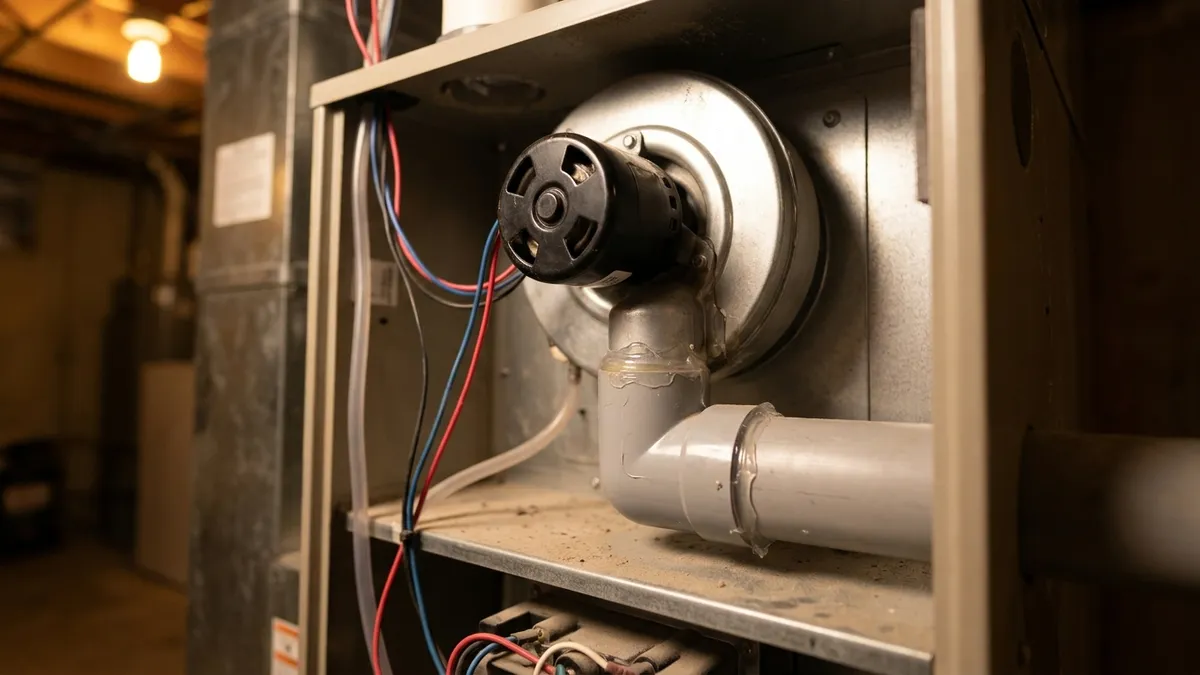
The inducer motor is the small fan at the top of a gas furnace that starts first every time the furnace turns on. It pulls air through the burners and heat exchanger and pushes exhaust out the vent. When it fails, the furnace can’t light at all, because the furnace’s safety controls won’t open the gas valve until the inducer proves it’s moving air. The most common signs are a furnace that never starts, a loud humming or grinding noise at startup, or a pressure switch error code.
Last updated: November 2026. Applies to most induced-draft gas furnaces (80% and 90%+ efficiency).
What the inducer motor does
Every heat cycle on a modern gas furnace starts the same way:
| Step | What happens |
|---|---|
| 1 | Thermostat calls for heat |
| 2 | Inducer motor starts and clears the heat exchanger and vent |
| 3 | Pressure switch closes, proving the inducer is moving enough air |
| 4 | Igniter heats up and the gas valve opens |
| 5 | Burners light, and the blower starts after a short delay |
| 6 | After the heat call ends, the inducer runs briefly to clear the vent, then stops |
If step 2 or 3 fails, nothing after it happens. That’s why a bad inducer looks like “the furnace is completely dead” even though the thermostat and power are fine.
Signs of a failing inducer motor
- The furnace doesn’t start, and you don’t hear the small fan spin up at the beginning of the cycle.
- Humming but no spinning. The motor gets power but can’t turn, often a seized bearing or a failed capacitor on motors that use one.
- Grinding, squealing or rattling at startup. Worn bearings or a loose or damaged fan wheel.
- Pressure switch error codes. A weak inducer may spin but not create enough suction to close the switch. See furnace pressure switch problems.
- The inducer runs, but the furnace never lights, and it keeps cycling. That’s usually the pressure switch, venting or drain rather than the motor itself.
- The inducer runs all the time, even when the thermostat isn’t calling for heat. This usually points to a control board fault or a safety switch that’s open.
Inducer error codes by brand
The control board doesn’t usually have a code just for “inducer failed”. Instead you’ll see the pressure switch code, because a dead or weak inducer can’t close the switch:
| Brand | Common code when the inducer fails |
|---|---|
| Carrier, Bryant, Payne | Code 31 (pressure switch did not close) |
| Goodman, Amana | 3 flashes (pressure switch open with inducer on) |
| Trane, American Standard | 3 flashes (pressure switch error) |
| Lennox | E223 or E227 (low pressure switch open) |
See Carrier, Goodman, Trane and Lennox codes, or furnace blinking light codes for other brands.
Inducer motor problem or something else?
| What you notice | Most likely cause |
|---|---|
| Inducer silent, no hum, no code | No power, control board not sending power, or a failed motor |
| Inducer hums but doesn’t spin | Seized bearings or failed motor |
| Inducer runs normally, pressure switch code | Blocked vent or intake, clogged drain, cracked hose (usually not the motor) |
| Inducer noisy, furnace still works | Worn bearings; the motor is near the end of its life |
| Inducer runs, burners light, then shut off | Flame sensor or limit switch. See how to clean a furnace flame sensor and furnace high limit switch |
What you can check safely
Turn the furnace off at the thermostat and at its service switch before touching anything inside.
- Confirm power. Check the furnace breaker and service switch, and make sure the front door panel is fully closed; the door safety switch cuts all power when it isn’t.
- Listen at startup. Turn the power back on, set the thermostat to heat and listen at the furnace. The inducer is usually the first sound you hear. Silence, a hum or a grinding noise tells you a lot.
- Check the vent pipes. On high-efficiency furnaces, clear any snow, ice or debris from the white PVC pipes outside. A blocked vent can make a good inducer look bad.
- Check the condensate drain. On 90%+ furnaces, water backing up into the inducer housing causes gurgling and pressure switch errors.
- Look at the status light. Write down the blinking code before you reset power, because a reset clears it.
Don’t try to oil, free or spin the motor by hand while it has power, and don’t bypass the pressure switch to see if the furnace will run. If the inducer isn’t working, the furnace shouldn’t light.
Repair or replace?
An inducer motor is a replaceable part, and replacing it is a common repair.
- Typical cost: about $400 to $1,000 installed, depending on the furnace brand, whether the part is a whole inducer assembly, and your region.
- Repair usually makes sense if the furnace is under about 15 years old and otherwise in good shape.
- Consider replacement if the furnace is near or past 15 to 20 years old, has needed several other repairs, or has a cracked heat exchanger. See how long a furnace lasts, furnace replacement cost and repair or replace your HVAC system.
When to call an HVAC technician
Call a licensed technician if the inducer hums but won’t spin, makes grinding or squealing noises, runs constantly, or the furnace shows a pressure switch code that clearing the vents and drain doesn’t fix. A technician can test the motor’s voltage and amperage, measure the suction with a manometer and confirm whether the motor, the pressure switch or the venting is at fault.
Frequently asked questions
Can a furnace run without the inducer motor?
No. Without a working inducer, the pressure switch stays open and the control board won’t open the gas valve. That’s a safety feature that keeps exhaust from building up inside the furnace.
Why is my furnace inducer motor so loud?
A loud hum, grinding or squeal usually means worn bearings or a damaged fan wheel. Some whoosh at startup is normal. A new or rising noise is a sign the motor is wearing out.
How long does an inducer motor last?
Often 10 to 20 years, but it varies with use, climate and installation. Noise is usually the first warning sign.
Why does my inducer motor run but the furnace won’t start?
The inducer is probably fine. The pressure switch isn’t closing, usually because of a blocked vent, a clogged drain or a cracked hose. See furnace pressure switch problems and furnace not turning on.
Disclaimer: this guide is for general information only. Gas furnaces involve gas, combustion and high voltage. If you smell gas, leave the house and call your gas utility from outside. When in doubt, contact a licensed HVAC professional.