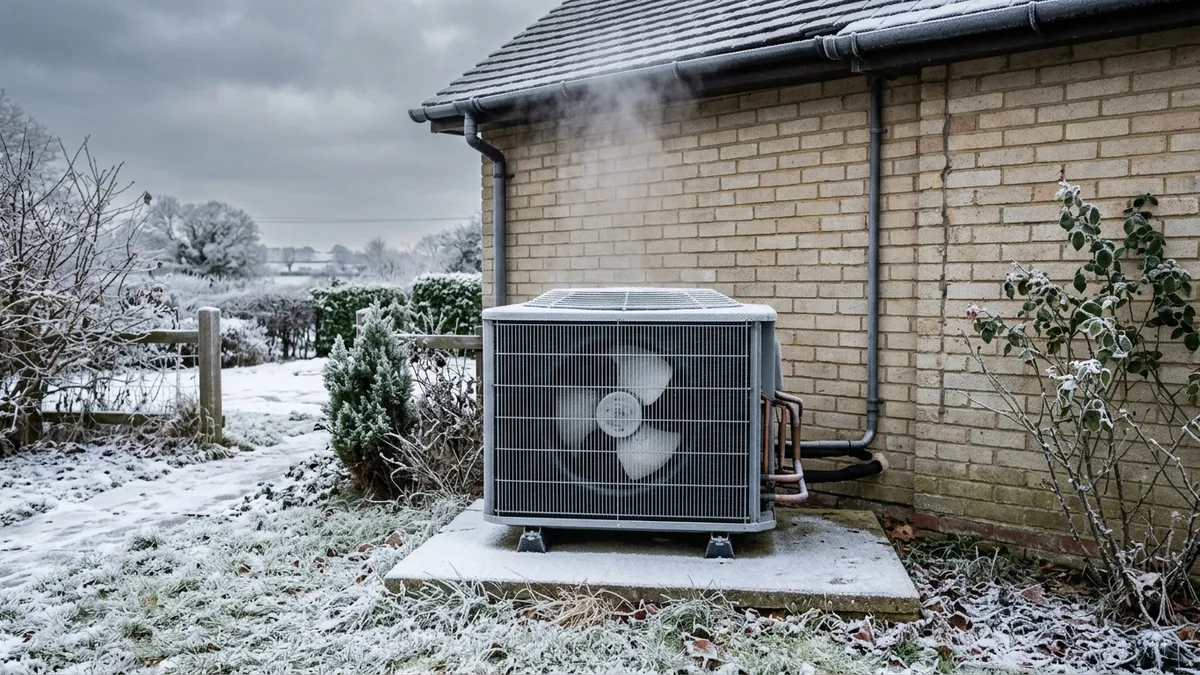
A heat pump that turns on and off every few minutes in winter is short cycling. Normal heating cycles usually last at least 10 to 15 minutes, and in cold weather a heat pump often runs for long stretches or even continuously. Very short cycles waste energy, wear out the compressor and leave rooms uneven. The most common causes are a thermostat problem, restricted airflow, an oversized system, a refrigerant or sensor problem, and, sometimes, something that only looks like short cycling: defrost mode.
Last updated: November 2026. Applies to air-source heat pumps with central air handlers.
First, rule out defrost mode
In cold, damp weather the outdoor coil collects frost. Every 30 to 90 minutes, the heat pump switches into defrost for about 5 to 15 minutes: the outdoor fan stops, you may see steam rising, and indoor air can feel cool. Then it goes back to heating. That stop-and-start is normal and isn’t short cycling. See heat pump defrost mode.
How to tell if it’s really short cycling
| What you notice | What it likely means |
|---|---|
| Runs 2 to 5 minutes, off a few minutes, repeats | Short cycling |
| Outdoor fan stops, steam rises, then heating resumes | Defrost (normal) |
| Runs for hours in very cold weather | Normal in cold weather |
| Outdoor unit starts and stops within seconds, clicking or humming | Electrical or compressor problem; call a technician |
| Heats briefly, then blows cool air for long periods | See heat pump blowing cold air |
Common causes of heat pump short cycling
1. Thermostat problems
- Bad location. A thermostat near a supply vent, in direct sun or near a heat source warms up quickly and shuts the system off early. See where a thermostat should be placed.
- Cycle settings. Many smart thermostats let you set a cycles-per-hour limit, a minimum run time or a temperature differential. A very small differential makes the system turn on and off more often.
- Power or wiring problems. A thermostat that reboots, or a loose wire, can interrupt the heat call. See thermostat wiring colors.
- Wrong equipment setup. If the thermostat is set up as the wrong system type, it can switch stages or modes erratically.
2. Restricted airflow
A dirty filter, closed vents, a dirty indoor coil or a weak blower reduces airflow. In heating mode, that can push system pressures and temperatures high enough for safety controls to shut the compressor off. Start with the filter: see how often to change your air filter.
3. An oversized heat pump
A heat pump that’s too large for the house heats the air near the thermostat very quickly and shuts off before the rest of the home is comfortable. Oversizing is common when equipment is replaced without a load calculation. Our heat pump size calculator gives a rough check; a proper Manual J calculation from a contractor is the real answer.
4. Low refrigerant or a sensor problem
A refrigerant leak can trip the heat pump’s low-pressure safety and make it cycle off. Faulty outdoor sensors or defrost controls can also start and stop cycles at the wrong times. Both need a licensed technician.
5. Electrical problems in the outdoor unit
A failing capacitor, contactor or compressor can make the outdoor unit start and stop within seconds, often with a click or hum. These are outdoor-unit repairs for a technician. See bad AC capacitor symptoms; the same parts are used in heat pumps.
What you can check safely
- Replace the air filter and make sure all supply vents and return grilles are open and unblocked.
- Clear snow, ice and debris from around the outdoor unit, keeping about 2 feet of space around it.
- Check the thermostat location and settings, and replace its batteries if it has them.
- Time the cycles. Note how long it runs and how long it rests. That information helps a technician find the cause faster.
When to call an HVAC technician
Call a technician if short cycling continues with a clean filter and a correctly placed thermostat, if the outdoor unit clicks, hums or starts and stops within seconds, if you see ice building up beyond normal frost, or if your electric bill jumps. Running a short-cycling heat pump for long periods can shorten compressor life. If the system leans on backup heat, also see heat pump emergency heat.
Frequently asked questions
How long should a heat pump run in winter?
It depends on the outdoor temperature. In mild weather, cycles of 10 to 20 minutes are common. In cold weather, long cycles or near-continuous running are normal, especially for variable-speed heat pumps.
Is it bad if my heat pump turns on and off a lot?
Frequent very short cycles add wear to the compressor and electrical parts and waste energy. A few cycles an hour is normal; cycles of only a few minutes, repeated all day, are not.
Can a dirty filter cause short cycling?
Yes. Restricted airflow is one of the most common causes, in both heating and cooling. Replace the filter first.
Does the thermostat cause short cycling?
Often. A thermostat in the wrong spot, with a very tight temperature differential, or losing power can all shorten cycles. The same is true for furnaces: see furnace short cycling.
Disclaimer: this guide is for general information only. HVAC systems involve high voltage and refrigerant. When in doubt, contact a licensed HVAC professional.