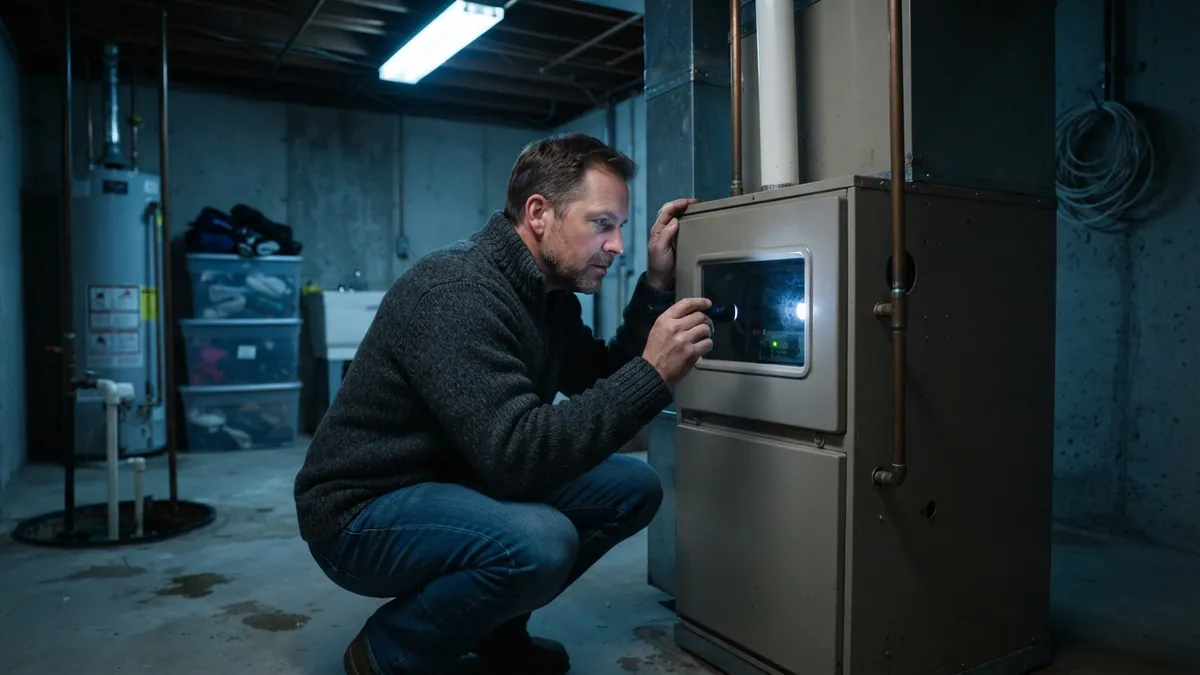
If your furnace won’t turn on, start with the simple things: the thermostat setting and batteries, the furnace power switch and breaker, the air filter, and the front panel door switch. Together these account for a large share of no-heat calls. If those check out, the most common failures are a dirty flame sensor, a bad hot surface igniter, a tripped limit switch, a clogged condensate drain on high-efficiency furnaces, or a pressure switch problem.
This guide covers 11 causes in the order a technician would check them, with what you can safely do and when to call a pro.
Safety first: if you smell gas (a rotten-egg odor), don’t touch light switches, the thermostat or the furnace. Leave the house immediately and call your gas utility or 911 from outside. Never bypass a safety switch to make a furnace run, and keep working carbon monoxide alarms near sleeping areas.
How a gas furnace starts
Knowing the startup sequence makes troubleshooting much easier. On a call for heat, a modern furnace:
- Receives a heat signal from the thermostat.
- Starts the inducer motor, which pushes air through the heat exchanger and out the vent.
- Confirms draft with the pressure switch.
- Heats the hot surface igniter until it glows (or sparks, on some models).
- Opens the gas valve; burners light.
- Proves the flame with the flame sensor within a few seconds.
- After a short delay, starts the blower to send warm air through the house.
If any step fails, the control board shuts the furnace down and usually flashes an error code through a small LED window on the blower compartment door. Write that code down before you power anything off; our furnace blinking light codes guide explains what they mean by brand.
Quick checks (10 minutes)
- Thermostat: set to HEAT, setpoint at least 3 to 5 degrees above room temperature. Replace the batteries if the display is blank or dim.
- Power switch: furnaces have a light-switch-style service switch on or near the unit, sometimes mistaken for a light switch. Make sure it’s ON.
- Breaker: check the furnace breaker in your main panel. Reset it once if tripped.
- Front panel: the blower compartment door presses a safety switch. If the panel is loose or off, the furnace won’t run.
- Air filter: a clogged filter can make the furnace overheat and shut itself off.
- Gas supply: make sure the gas shutoff valve near the furnace is open (handle parallel to the pipe) and that other gas appliances work.
Symptoms at a glance
| What you notice | Likely cause | DIY? |
|---|---|---|
| Nothing happens at all, no sounds | Thermostat, power switch, breaker, door switch, blown fuse | Mostly yes |
| Inducer runs, then furnace stops | Pressure switch, blocked vent or drain | Partly |
| Igniter doesn’t glow | Bad igniter or control problem | No |
| Burners light for a few seconds, then shut off | Dirty flame sensor | Yes, with care |
| Burners run, but blower never starts | Blower motor, capacitor or control board | No |
| Runs briefly and shuts off repeatedly | Overheating (filter, closed vents), short cycling | Partly |
| Error light flashing | Depends on the code | Look it up first |
1. Thermostat problems
A thermostat set to COOL or OFF, dead batteries, a smart thermostat schedule or a loose wire can all keep the furnace from getting a heat signal. Smart thermostats without a common (C) wire sometimes lose power and stop calling for heat.
What to do: check the settings and batteries. If the thermostat has power but the furnace never responds, the issue may be wiring or the control board. See thermostat blank screen fixes.
2. No power to the furnace
What to do: check the service switch, the breaker and the panel door switch. Inside, many control boards have a small automotive-style 3- or 5-amp fuse. A blown fuse usually means a short somewhere, often a thermostat wire, so replacing the fuse without finding the cause may just blow it again.
3. Dirty air filter and overheating
A clogged filter restricts airflow, so heat builds up inside the furnace until the high-limit switch shuts the burners off. The furnace may then restart and repeat the cycle.
What to do: replace the filter and open all supply vents and returns. See how often to change your air filter.
4. Dirty flame sensor
The flame sensor is a thin metal rod that sits in the burner flame. If it’s coated with carbon buildup, the furnace can’t confirm the flame and shuts the gas off after a few seconds. This is one of the most common furnace problems.
Symptoms: the burners light, run for 3 to 10 seconds, then shut off; the furnace tries again several times and then locks out.
What to do: cleaning the sensor is a common homeowner task if you’re comfortable turning off power and gas and removing one screw. See our step-by-step guide on how to clean a furnace flame sensor.
5. Bad hot surface igniter
Most modern furnaces use a hot surface igniter that glows orange like a toaster element. Igniters are brittle and wear out, usually after several years.
Symptoms: the inducer runs and you hear the furnace try to start, but the igniter never glows and the burners don’t light.
What to do: call a technician. See furnace ignitor not glowing for causes and costs.
6. Pressure switch or blocked venting
The pressure switch confirms the inducer is moving combustion gases out of the furnace. If the vent pipe is blocked by a bird’s nest, snow or ice, if the switch’s small hose is cracked or full of water, or if the inducer is weak, the switch won’t close and the furnace stops.
What to do: on high-efficiency furnaces, check that the two white PVC pipes outside the house are clear of snow, ice, leaves and nests. Leave switch testing to a professional; never bypass it.
7. Clogged condensate drain (high-efficiency furnaces)
High-efficiency furnaces (90% AFUE and higher) produce water as they run. If the drain line, trap or condensate pump clogs, water backs up and a safety switch stops the furnace.
What to do: check for water in the furnace or around the base, and flush the drain line. The process is similar to clearing an AC condensate line. If your furnace uses a condensate pump, make sure it’s plugged in and running.
8. Gas supply problems
What to do: confirm the gas valve near the furnace is open and other gas appliances work. If you’re on propane, check the tank level. If gas service was shut off, the utility must restore it and relight pilots. Never attempt to repair gas valves or lines yourself.
9. Blower motor problems
Symptoms: the burners light, but no air comes from the vents, and the furnace soon shuts off on its high-limit switch; or you hear humming from the blower compartment.
What to do: call a technician. A failed blower motor or its capacitor are common causes; blower motor replacement often costs $400 to $1,500.
10. Control board failure
The control board runs the entire sequence. Boards can fail from age, power surges or moisture.
Symptoms: no response even with power, erratic behavior, or a board LED that’s off or shows a control fault code.
What to do: call a technician. A board replacement typically costs $300 to $800.
11. Furnace lockout
After several failed ignition attempts, most furnaces lock out for about an hour as a safety measure.
What to do: turn the furnace power off for 30 seconds, then back on, to reset it once. If it locks out again, there’s an underlying problem from the list above. Repeated resets without fixing the cause aren’t safe.
When to call a professional
Call a licensed HVAC technician if:
- You smell gas or your CO alarm sounds (leave first and call from outside).
- The furnace keeps locking out after one reset.
- The igniter, gas valve, pressure switch, inducer, blower or control board seems to be the problem.
- You see scorch marks, melted wires or rust and water inside the cabinet.
- The furnace is 15 to 20 years old and failing repeatedly. See how long a furnace lasts.
If your furnace has a status light, look up the code for your brand: Carrier, Goodman, Trane or Lennox. Thermostat not calling for heat? See Honeywell thermostat not working or Nest thermostat not cooling or heating.
If the thermostat shows it’s calling for heat but nothing happens, work through thermostat says heat on but no heat.
If the inducer fan runs but the furnace never lights, see furnace pressure switch problems.
Don’t hear the small fan start at the beginning of the cycle? See furnace inducer motor problems.
Frequently asked questions
Why is my furnace not turning on but the thermostat is?
Check the furnace power switch, the breaker, the blower door switch and the board fuse. If those are fine, look at the error code on the control board.
How do I reset my furnace?
Turn off the furnace service switch or breaker, wait 30 seconds, and turn it back on. Some older furnaces have a red reset button on the blower motor, but pressing it repeatedly can damage the motor. If the furnace needs resetting often, call a technician.
Can a dirty filter stop a furnace from working?
Yes. A clogged filter can cause the furnace to overheat and shut off on its high-limit safety switch.
Is it safe to run my furnace if it keeps shutting off?
Not for long. Repeated shutoffs mean a safety device is doing its job. Find and fix the cause.
Disclaimer: this guide is for general information only. Gas furnaces involve combustion, gas lines and high voltage. If you smell gas, leave your home and call your gas utility or 911 from outside. Contact a licensed HVAC professional for repairs.