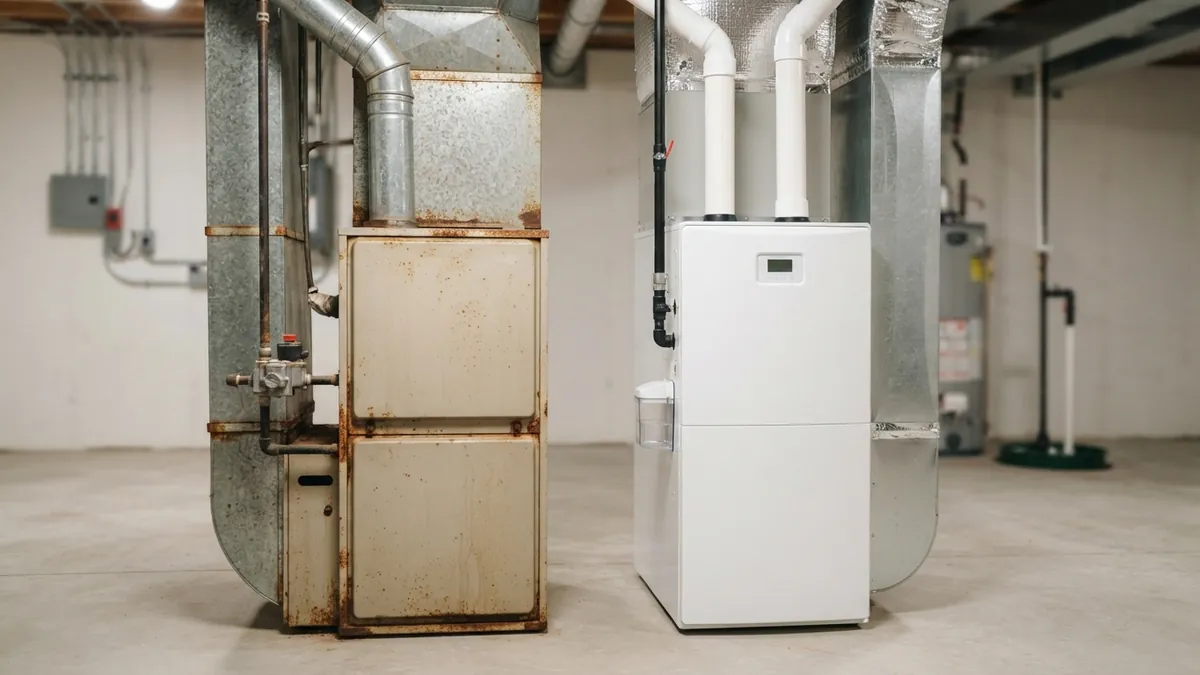
A gas furnace typically lasts 15 to 20 years, and well-maintained units in moderate climates can run 20 to 30 years. Electric furnaces often last 20 to 30 years. The furnace’s age alone doesn’t mean it must be replaced, but once it passes about 15 years, repairs, efficiency and safety deserve a closer look.
Here’s what affects lifespan and the 9 signs it’s time to start planning a replacement.
Typical furnace lifespan by type
| Type | Typical lifespan |
|---|---|
| Gas furnace (standard, 80% AFUE) | 15 to 20 years |
| High-efficiency gas furnace (90% AFUE and higher) | 15 to 20 years |
| Electric furnace | 20 to 30 years |
| Oil furnace | 15 to 25 years |
| Heat pump (for comparison) | 10 to 15 years |
What affects how long a furnace lasts
- Maintenance: annual tune-ups and regular filter changes are the biggest factors you control.
- Installation quality: correct sizing, gas pressure, airflow and venting.
- Sizing: an oversized furnace short cycles and wears out faster. See furnace short cycling.
- Climate and use: furnaces in the Upper Midwest and Northeast work much harder than in the South.
- Airflow: clogged filters and restrictive ducts make the heat exchanger run hot, which stresses the metal over time.
- Humidity and corrosion: basements and crawl spaces with moisture problems shorten equipment life.
How to find your furnace’s age
Look for the data plate inside the furnace door or on the side of the cabinet. The serial number usually encodes the manufacture date, often as the first four digits (year and week, or week and year depending on the brand). The manufacturer’s customer service line can decode it from the serial number. Installation paperwork or a permit record also helps.
9 signs it’s time to replace your furnace
- It’s more than 15 to 20 years old and needs a significant repair.
- Repairs are frequent: two or more major repairs in two years.
- A big repair is needed: a cracked heat exchanger, failed inducer on an old unit, or a control board on a furnace near the end of its life. Use the repair or replace $5,000 rule.
- Heating bills keep rising with no change in rates or usage.
- Uneven heating: some rooms are cold while others are hot, and duct and airflow fixes haven’t helped.
- Yellow or flickering burner flames instead of steady blue flames, which can indicate combustion problems. Have it inspected.
- Carbon monoxide concerns: CO alarms sounding, soot around the furnace, or headaches and nausea that improve away from home. Leave and call 911 or your gas utility, and don’t use the furnace until it’s inspected.
- Unusual noises: banging, rattling, screeching or loud booms at startup. See furnace making a loud bang.
- Rust, water or corrosion inside the cabinet or on the heat exchanger.
Repair or replace?
Consider replacing when the furnace is 15 or more years old and the repair costs more than a few hundred dollars, or when the heat exchanger is cracked. If your central AC is also old, replacing both together usually saves on labor and gets you matched equipment. If you’d like heating and cooling from one system, compare a heat pump vs. a furnace.
For prices, see our furnace replacement cost guide.
How to make your furnace last longer
- Change the filter every 1 to 3 months.
- Schedule an annual tune-up in the fall.
- Keep the area around the furnace clear and dry.
- Keep supply vents and returns open.
- Keep high-efficiency furnace vent pipes outside clear of snow and debris.
See our seasonal HVAC maintenance checklist.
Frequently asked questions
Can a furnace last 30 years?
Some do, especially in mild climates with good maintenance, but older furnaces are much less efficient and should be inspected carefully for heat exchanger cracks.
Should I replace a 20-year-old furnace that still works?
Not necessarily. If it’s safe, inspected annually and your bills are reasonable, you can keep it, but start budgeting so a mid-winter failure doesn’t force a rushed decision.
What fails most often on older furnaces?
Igniters, flame sensors, inducer motors, blower motors, control boards and pressure switches. A cracked heat exchanger is the most serious failure.
Disclaimer: this guide is for general information only. If you suspect carbon monoxide, leave your home immediately and call 911 or your gas utility from outside.