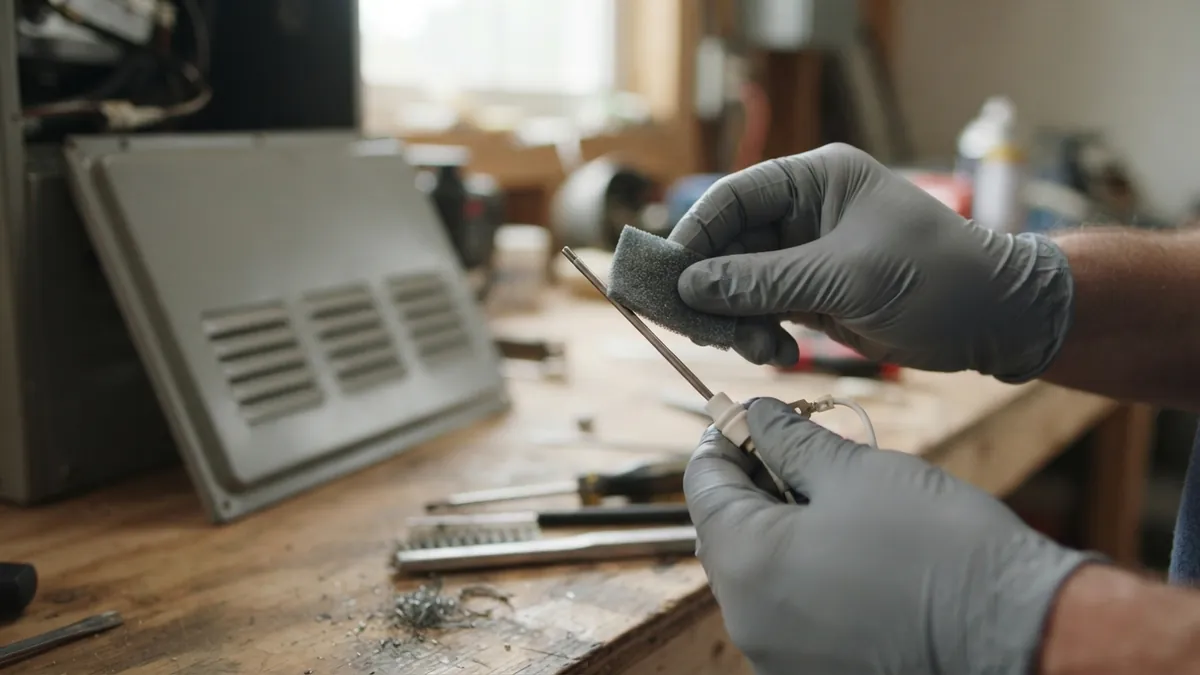
A dirty flame sensor is one of the most common reasons a gas furnace lights for a few seconds and then shuts off. Cleaning it takes about 15 minutes, costs nothing, and is a job many homeowners can do safely if they turn off the power and gas first and handle the sensor gently. You’ll need a 1/4-inch nut driver or screwdriver and a fine abrasive pad or very fine sandpaper.
What the flame sensor does
The flame sensor is a thin metal rod, usually with a white porcelain base, positioned in the path of one burner flame. When the burners light, the flame conducts a tiny electrical current through the sensor. The control board reads that current as proof that the gas is burning. If it doesn’t detect a flame within a few seconds, it shuts the gas valve as a safety measure.
Over time, the rod gets coated with a thin layer of carbon and oxidation. That coating weakens the signal, and the board shuts the burners off even though the flame is there.
Signs of a dirty flame sensor
- The burners light, run for about 3 to 10 seconds, then shut off.
- The furnace tries to restart several times, then locks out.
- The control board flashes a flame sense or ignition failure code. See our furnace blinking light codes guide.
- The sensor rod looks dull, dark or crusty instead of shiny metal.
What you’ll need
- A 1/4-inch nut driver or screwdriver (most sensors are held by one screw)
- A fine abrasive pad (such as a non-scratch kitchen scouring pad), fine steel wool, or 400-grit or finer emery cloth
- A clean paper towel
- A flashlight
- Your phone, to take a photo before removing anything
How to clean a furnace flame sensor
- Turn off the power. Switch off the furnace service switch and the breaker.
- Turn off the gas. Turn the gas valve handle near the furnace so it’s perpendicular to the pipe.
- Wait for the furnace to cool if it was running. Burner areas get very hot.
- Remove the front panels. Usually the top burner panel lifts up and out. Take a photo of the area before touching anything.
- Find the flame sensor. Look at the burner assembly: it’s a thin bent metal rod with a white porcelain insulator and a single wire, positioned in front of one burner. Don’t confuse it with the igniter, which is flat or coil-shaped, fragile and usually has two wires.
- Remove the sensor. Remove the single screw holding it and gently slide it out. You may need to disconnect the wire; pull on the connector, not the wire.
- Clean the rod. Gently rub the metal rod with the abrasive pad until it’s clean and shiny. Don’t use coarse sandpaper, which can scratch the rod and make carbon build up faster. Don’t touch the porcelain or bend the rod.
- Wipe it off with a clean paper towel. Avoid touching the clean rod with your fingers.
- Reinstall it in the same position, reconnect the wire, and replace the screw.
- Restore gas and power. Turn the gas valve back on (handle parallel to the pipe), replace the panels, and turn the power on.
- Test. Set the thermostat to call for heat and watch for the burners to light and stay lit beyond 10 seconds.
If cleaning doesn’t fix it
- Check the sensor’s position. It must sit in the flame. A bent bracket can move it.
- Check the porcelain. A cracked insulator means the sensor needs replacing; they’re inexpensive, but technicians usually charge $100 to $250 including the visit.
- Check grounding. Poor grounding of the furnace or burner assembly causes similar symptoms.
- Check the flame itself. A weak, yellow or lifting flame can’t heat the sensor properly. That calls for a technician.
How often to clean the flame sensor
Once a year is usually enough. Ask your technician to clean it during the annual furnace tune-up. See our seasonal HVAC maintenance checklist.
When to call a professional
- You’re not comfortable shutting off gas and power or removing furnace panels.
- You smell gas at any point. Leave and call your gas utility or 911 from outside.
- The furnace still shuts off after cleaning.
- The igniter cracked or broke while you were working. Don’t run the furnace; call for service.
Frequently asked questions
How do I know if my flame sensor is bad or just dirty?
If the furnace runs normally after cleaning, it was dirty. If the problem returns quickly or the porcelain is cracked, the sensor may need replacing. A technician can measure the flame signal in microamps to confirm.
Can I clean a flame sensor with steel wool?
Fine steel wool or a non-scratch pad works. Avoid coarse sandpaper.
How much does it cost to replace a flame sensor?
The part is typically $15 to $40; a professional replacement usually costs $100 to $250 including the service call.
Why does my furnace turn off after a few seconds?
A dirty flame sensor is the most common cause. Other causes include poor grounding, a weak flame or a control board problem. See Furnace Not Turning On: 11 Causes and Fixes.
Disclaimer: this guide is for general information only. Working on a gas furnace involves gas, electricity and hot surfaces. If you’re not comfortable, contact a licensed HVAC professional. If you smell gas, leave your home and call your gas utility or 911 from outside.