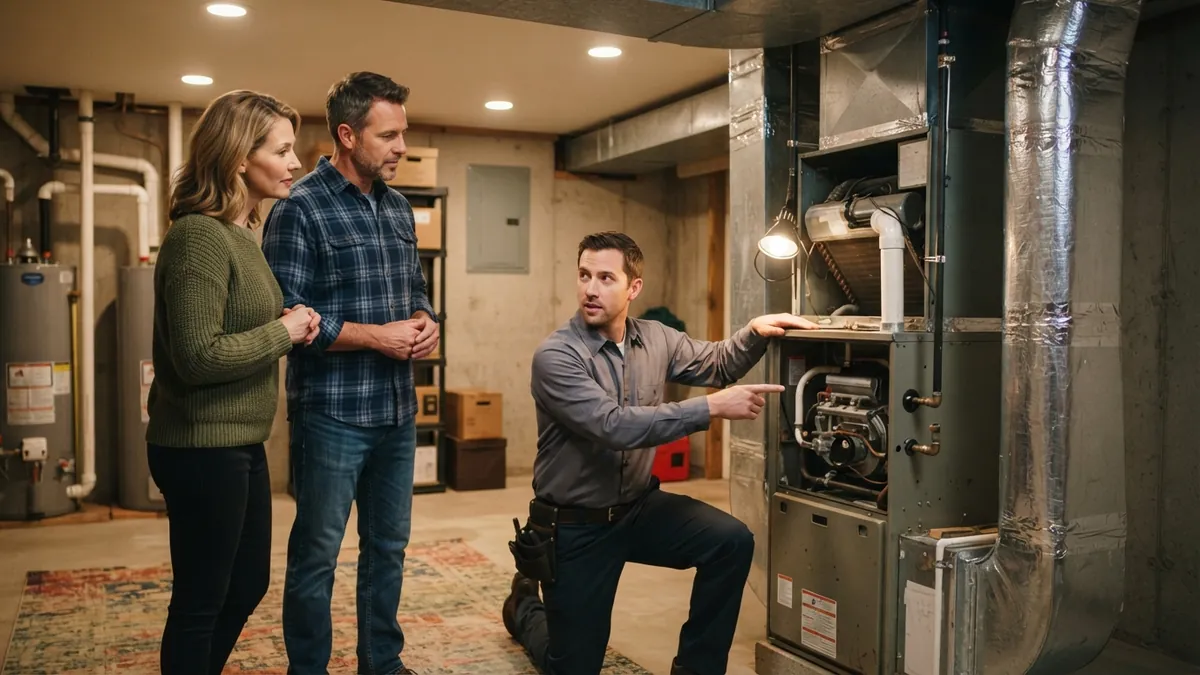
A simple way to decide whether to repair or replace your AC, heat pump or furnace is the $5,000 rule: multiply the age of the system in years by the cost of the repair. If the result is more than $5,000, replacing the system usually makes more financial sense. If it’s less, repair it.
The rule is a starting point, not the whole answer. Below is how to use it, when to break it, and a checklist that covers the factors it leaves out.
How the $5,000 rule works
Age (years) × repair cost ($) = score
- Under $5,000: repair.
- Over $5,000: seriously consider replacing.
| System age | Repair cost | Score | Suggestion |
|---|---|---|---|
| 5 years | $450 (capacitor) | 2,250 | Repair |
| 8 years | $1,200 (fan motor + service) | 9,600 | Check warranty first; often repair if parts are covered |
| 12 years | $350 (contactor) | 4,200 | Repair |
| 12 years | $1,800 (refrigerant leak) | 21,600 | Replace |
| 15 years | $600 (blower motor) | 9,000 | Replace, or repair only as a short-term bridge |
| 18 years | $250 (igniter) | 4,500 | Repair, but start budgeting for replacement |
Some contractors use a higher threshold, such as $6,000 to $7,000, because equipment prices have risen. Treat anything between $5,000 and $7,000 as a gray zone where the other factors below should decide.
Typical lifespan of HVAC equipment
| Equipment | Typical lifespan |
|---|---|
| Central air conditioner | 12 to 15 years |
| Heat pump | 10 to 15 years |
| Gas furnace | 15 to 20+ years |
| Boiler | 20 to 30 years |
| Ductless mini split | 12 to 20 years |
| Ductwork | 20 to 30 years |
Climate matters: an AC in Phoenix works far harder than one in Minneapolis, and a coastal unit faces salt corrosion.
When to repair even if the score is high
- The part is under warranty. Many systems carry a 10-year parts warranty if registered. A covered compressor may cost only labor. Check with the manufacturer using your model and serial number.
- You plan to move soon. A repair can make more sense than a new system you won’t use for long.
- The system was well maintained and has had few problems.
- Budget timing. A repair can buy time to save, compare quotes, or wait for the off-season.
When to replace even if the score is low
- Your system uses R-22. R-22 production ended in 2020 and recharges are very expensive. See our R-410A phase-out guide for how refrigerants affect your decision.
- Frequent breakdowns. Two or more significant repairs in two years is a warning sign.
- Rising energy bills with no change in usage.
- Comfort problems the system can’t solve: hot or cold rooms, high humidity, constant running.
- Safety concerns: a cracked furnace heat exchanger or repeated carbon monoxide alarms. Replace immediately and stop using the furnace until it’s inspected.
Repair vs. replace checklist
Give one point for each “yes”:
- The system is older than 12 years (AC or heat pump) or 15 years (furnace).
- Age × repair cost is over $5,000.
- It uses R-22.
- It has needed two or more major repairs in the past two years.
- Energy bills have risen noticeably.
- Some rooms are uncomfortable or humidity is hard to control.
- The repair is a compressor, heat exchanger or coil.
- The equipment is out of warranty.
0 to 2 points: repair. 3 to 4: get a repair quote and a replacement quote and compare. 5 or more: replacement is likely the better investment.
Compare the real costs
| Repair | Replace | |
|---|---|---|
| Up-front cost | Lower | Higher: often $6,000 to $12,000 for central AC |
| Energy bills | Unchanged | Lower with a more efficient system |
| Future repairs | Likely, as other parts age | Covered by new warranty for years |
| Comfort | Unchanged | Can improve, especially with two-stage or variable-speed |
See current prices: AC repair cost and central AC replacement cost.
Questions to ask your contractor
- What exactly failed, and how did you test it?
- Is the part covered by the manufacturer’s warranty?
- What other parts are worn and likely to fail soon?
- What would a replacement cost, and what size system does my home need? Ask for a Manual J.
- Is this repair a long-term fix or a short-term bridge?
Be cautious if a contractor pushes replacement on a young system for a minor repair, or recommends repeated refrigerant top-offs without finding the leak.
Frequently asked questions
Is it worth repairing a 15-year-old AC?
Small repairs can be worth it. For anything major, such as a compressor, coil or refrigerant leak, replacement is usually the better choice at that age.
How much should I spend on repairing an old furnace?
Use the same rule: if the furnace’s age times the repair cost is over $5,000, consider replacing it, especially if it’s over 15 years old.
Does replacing an AC increase home value?
A newer system is a selling point and can help a home sell faster, though you rarely recover the full cost in the sale price.
Disclaimer: this guide is for general information only. Decisions about safety components like furnace heat exchangers should always be made with a licensed HVAC professional.