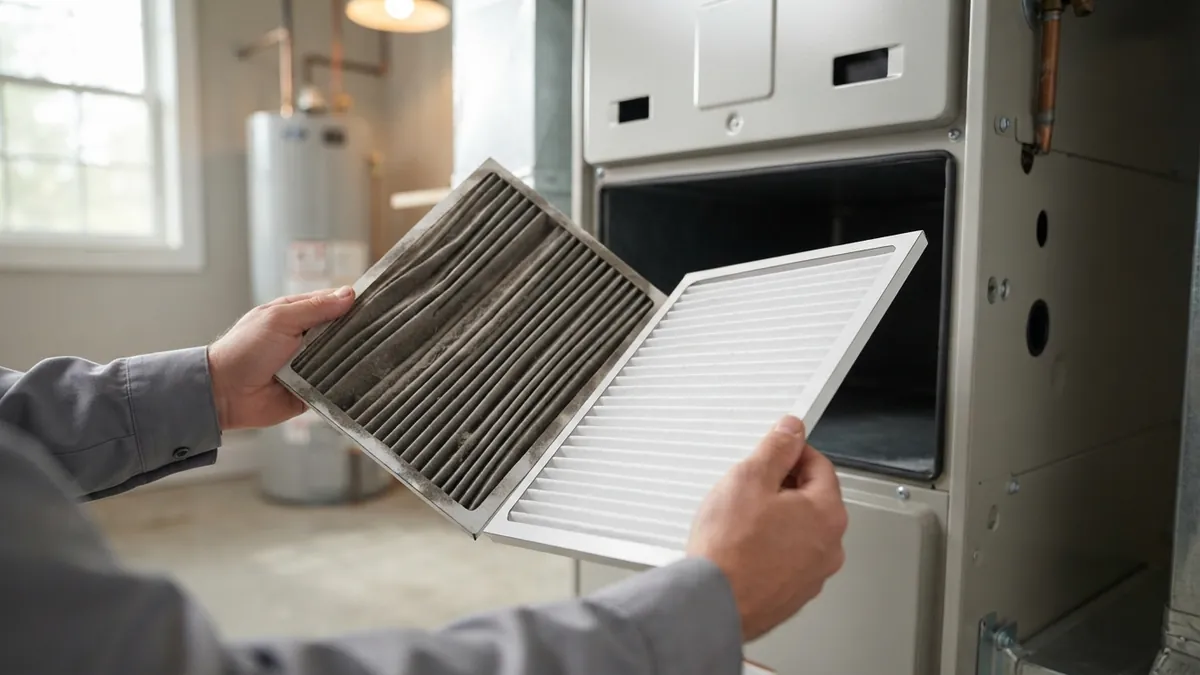
Most homes should change a standard 1-inch HVAC air filter every 1 to 3 months. Change it every month if you have pets, allergies or a dusty home, or if your system runs constantly in peak summer or winter. Thicker 4- to 5-inch media filters usually last 6 to 12 months.
The filter’s label gives a maximum interval, but your home decides the real one. Here’s how to find the right schedule and pick the right filter.
Air filter replacement schedule
| Filter type | Typical home | Pets or allergies | Vacation home or light use |
|---|---|---|---|
| 1-inch fiberglass (MERV 1 to 4) | Every 30 days | Every 30 days | Every 60 days |
| 1-inch pleated (MERV 8 to 13) | Every 60 to 90 days | Every 30 to 45 days | Every 90 days |
| 2-inch pleated | Every 3 to 4 months | Every 2 months | Every 6 months |
| 4- to 5-inch media | Every 6 to 12 months | Every 4 to 6 months | Every 12 months |
| Washable/reusable | Clean monthly | Clean every 2 to 3 weeks | Clean every 2 months |
Always follow the filter and equipment manufacturer’s guidance where it differs.
When to change it sooner
- You have one or more pets that shed.
- Someone in the home has allergies or asthma.
- It’s peak cooling or heating season and the system runs most of the day.
- There’s been renovation, sanding or drywall work.
- Wildfire smoke or high pollen outdoors.
- You live on a dirt road or in a dusty, dry climate.
- Smokers live in the home.
How to tell your filter needs changing
- It looks gray or brown and you can’t see light through it when you hold it up.
- Airflow from the vents feels weaker.
- More dust is settling on furniture.
- The system runs longer than usual.
- In summer, ice forms on the indoor coil or copper lines; a clogged filter is a top cause of a frozen evaporator coil.
Why it matters
A clogged filter restricts airflow, so the blower works harder and the system runs longer. Over time that means higher energy bills, a less comfortable home, and more strain on expensive parts. A dirty filter is one of the first things to check if your AC isn’t cooling.
Choosing the right filter: MERV ratings
MERV (Minimum Efficiency Reporting Value) rates how well a filter captures particles, from 1 to 16 for residential filters.
| MERV | Captures | Best for |
|---|---|---|
| 1 to 4 | Large dust, lint | Basic equipment protection only |
| 5 to 8 | Dust, pollen, mold spores, pet hair | Most homes; good airflow |
| 9 to 12 | Finer dust, some smoke, pet dander | Homes with pets or mild allergies |
| 13 | Smoke, bacteria-size particles, fine dust | Allergies, wildfire smoke; check that your system can handle it |
For most homes, MERV 8 to 11 is the best balance of filtration and airflow. MERV 13 filters catch more fine particles, but a 1-inch MERV 13 filter can restrict airflow in systems that weren’t designed for it. Thicker 4-inch MERV 13 filters avoid most of that problem because they have more surface area. We compare the options in detail in our MERV 8 vs. MERV 11 vs. MERV 13 guide.
How to change an HVAC air filter
- Turn the system off at the thermostat.
- Find the filter. It’s usually in a slot on the furnace or air handler, or behind a return grille in a wall or ceiling. Some homes have filters in several return grilles.
- Note the size printed on the edge of the old filter, for example 16x25x1. Sizes are nominal; buy the size printed on your old filter.
- Remove the old filter and slip it into a trash bag to keep the dust contained.
- Insert the new filter with the arrow pointing toward the blower, which means away from the return grille and toward the furnace or air handler.
- Close the panel or grille and turn the system back on.
- Write the date on the new filter’s edge or set a phone reminder.
Tips to make it easier
- Buy filters in multipacks to save money and always have one on hand.
- Set a recurring calendar reminder, or use a smart thermostat that tracks filter runtime.
- Consider a subscription service that ships the right size on your schedule.
- If your system has a 1-inch slot and you want better filtration with less airflow restriction, ask a contractor about adding a 4- or 5-inch media cabinet.
Frequently asked questions
What happens if you don’t change your air filter?
Airflow drops, energy use rises, and the system works harder. Over time it can lead to a frozen AC coil, an overheating furnace that shuts off on its safety limit, and dirtier ducts and coils.
Can I run my HVAC without a filter?
Only briefly in an emergency. Without a filter, dust coats the blower and the indoor coil, which reduces efficiency and can lead to costly cleaning or repairs.
Do more expensive filters last longer?
Not necessarily. Higher-MERV pleated filters capture more particles, so in a dusty home they can load up just as fast. Thickness, not price, is the main factor in how long a filter lasts.
Which way does the arrow go on an air filter?
The arrow points in the direction of airflow: toward the blower and furnace, away from the return duct.
For other routine tasks, see our seasonal HVAC maintenance checklist.
Disclaimer: this guide is for general information. Follow your equipment manufacturer’s instructions for filter type and size.