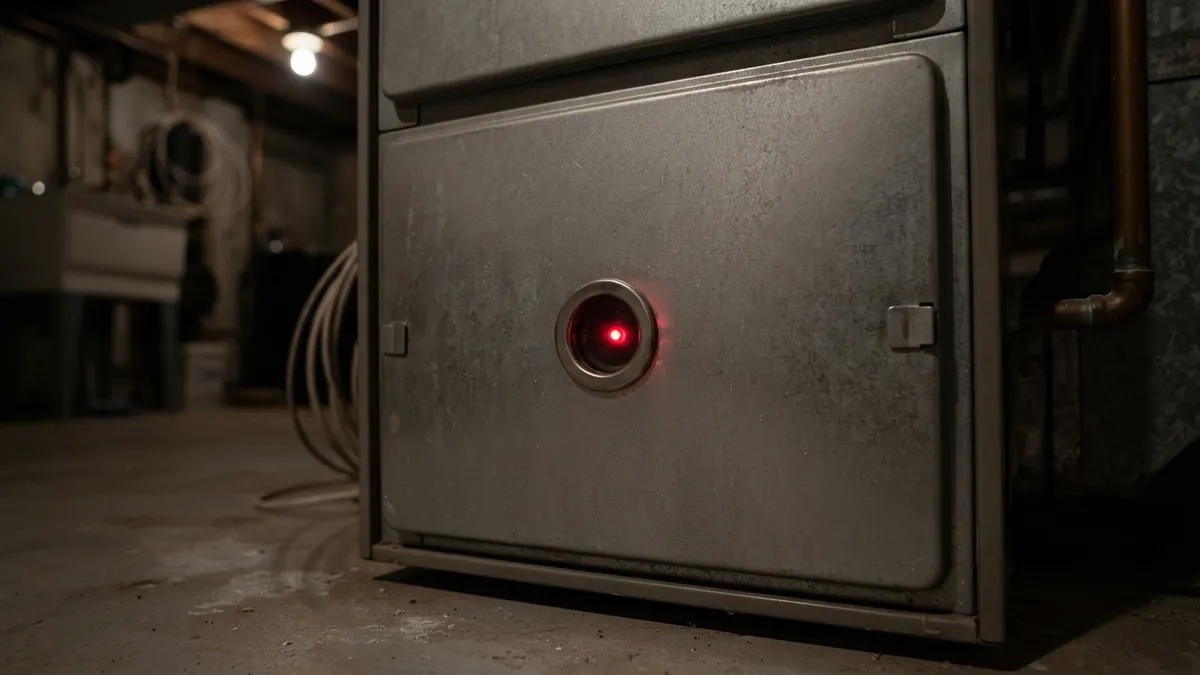
A blinking light on your furnace is a diagnostic code from the control board telling you why the furnace stopped or won’t start. Each brand uses its own system: Goodman, Amana, Daikin and Trane count the number of flashes; Carrier, Bryant and Payne use two-digit codes made of short and long flashes; newer Lennox furnaces show codes such as “E 250” on a small digital display. In every case, the most common codes point to the same handful of problems: ignition failure, a pressure switch fault, an open limit switch, or a weak flame signal.
This guide shows how to read the code, what the most common codes mean across brands, and links to a full code list for each brand.
Safety first: if you smell gas, leave the home and call your gas utility or 911 from outside. Never bypass a safety switch to make a furnace run. Codes for rollout switches, flame sensed with the gas valve off, or gas valve faults should always be handled by a licensed technician.
How to read your furnace’s code
- Don’t turn off the power yet. Most boards show the code only while powered, and some clear the code when power is cut.
- Find the LED. Look through the small sight window on the lower (blower) door of the furnace. Older and some newer furnaces show a red, green or amber LED; some show a one- or two-character digital display.
- Count the flashes. Watch at least two full cycles. Codes repeat after a pause of a few seconds.
- Note the pattern: number of flashes, or short and long flashes, or the characters on the display. Take a phone video if it’s hard to count.
- Check the label. Nearly every furnace has a wiring diagram and code chart glued inside the blower door. That label is the authority for your exact model, because codes differ between control boards even within one brand.
- Then look up the meaning in the brand sections below.
Normal light patterns
| Pattern | Usually means |
|---|---|
| Steady on, or slow steady blink | Normal: power on, no fault (exact meaning varies by brand) |
| Rapid continuous flashing | On several brands, line voltage polarity reversed or a grounding problem |
| Off | No power to the board: check the power switch, breaker, door switch and fuse |
The most common codes, by problem
| Problem | What it means | Typical fix |
|---|---|---|
| Ignition lockout | The furnace tried several times to light and prove flame, then locked out | Clean the flame sensor, check gas supply, check the igniter |
| Pressure switch open / did not close | The board didn’t confirm venting draft | Clear blocked vent pipes or drains, check the switch hose; technician for switch or inducer |
| Pressure switch stuck closed | The switch reads closed before the inducer starts | Usually a failed switch; technician |
| High limit open | The furnace overheated | Replace the air filter, open vents; technician if it repeats |
| Rollout switch open | Flames rolled out of the burner area; can indicate a blocked or cracked heat exchanger | Technician only. Don’t reset repeatedly |
| Low flame signal | The flame sensor reads a weak signal | Clean the flame sensor; check grounding |
| Flame sensed with gas valve off | Flame detected when it shouldn’t be | Technician only (gas valve or board) |
| Polarity or ground fault | Hot and neutral wires reversed or poor ground | Electrician or technician |
Codes by brand
Goodman, Amana and Daikin
Most models use a red LED that flashes 1 to 9 times. For example, 1 flash is a lockout after repeated ignition failures, 3 flashes is a pressure switch that didn’t close, and 4 flashes is an open high limit. Full list: Goodman furnace error codes.
Carrier, Bryant and Payne
These furnaces use two-digit status codes shown as short flashes followed by long flashes. For example, code 31 (3 short, 1 long) means the pressure switch didn’t close, code 33 is a limit circuit fault, and code 34 is an ignition proving failure. Full list: Carrier furnace error codes.
Trane and American Standard
Most models use a red LED that flashes 2 to 9 times. For example, 2 flashes is a lockout after failed retries, 3 flashes is a pressure switch error, and 4 flashes is an open limit switch. Full list: Trane furnace error codes.
Lennox
Newer Lennox furnaces show codes such as “E 223” (low pressure switch failed open), “E 250” (limit switch circuit open) or “E 270” (lockout after too many failed ignition retries) on a small display. Older models use two LEDs that flash in combinations. Full list: Lennox furnace error codes.
How to reset a furnace after an error code
- Write down or record the code first.
- Fix the obvious cause if there is one (dirty filter, blocked vent pipe, closed gas valve).
- Turn off the furnace power switch or breaker for 30 seconds, then turn it back on.
- Watch whether the furnace completes a normal cycle.
Reset only once or twice. If the code comes back, the underlying problem needs repair. Rollout, flame-sensed-with-valve-off, gas valve and polarity codes should go straight to a professional. For a full troubleshooting sequence, see Furnace Not Turning On: 11 Causes and Fixes.
For a deeper look at the two most common faults behind these codes, see furnace pressure switch problems and furnace high limit switch tripping.
Pressure switch codes are often caused by a weak inducer. See furnace inducer motor problems.
Frequently asked questions
Why is my furnace light blinking but the furnace is working?
Many boards blink slowly or steadily during normal operation. Check the code label inside the furnace door to confirm whether the pattern is a status signal or a fault.
Does a blinking furnace light mean I need a new furnace?
Rarely. Most codes point to inexpensive problems such as a dirty filter, a dirty flame sensor, a blocked vent or a failed igniter.
Where is the furnace code chart?
Usually on a label inside the lower blower compartment door, alongside the wiring diagram. It’s also in the installation and service manual for your model.
Sources
Brand code tables are based on manufacturer service literature where available, including Lennox EL296DFE service literature, and cross-checked against published contractor references for Goodman, Amana and Daikin and Trane and American Standard. Codes vary by control board, so always confirm with the label on your furnace.
Disclaimer: this guide is for general information only. Gas furnaces involve gas, combustion and high voltage. Contact a licensed HVAC professional for repairs.