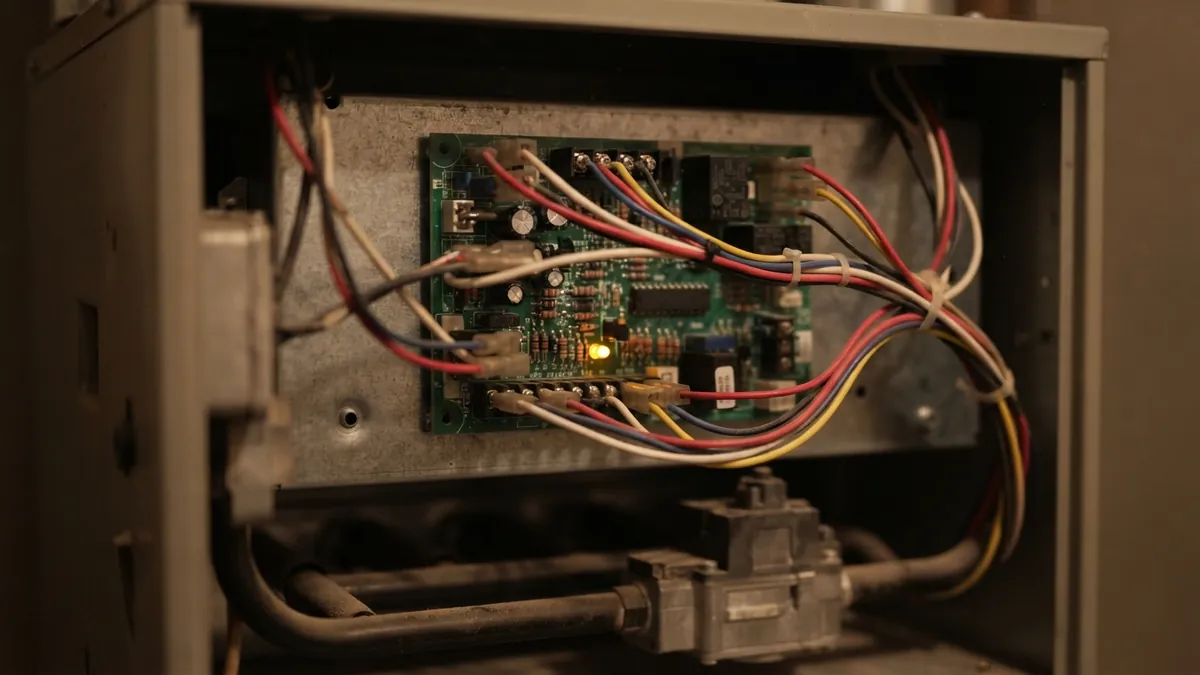
Carrier furnaces, and Bryant and Payne furnaces from the same manufacturer, show two-digit status codes with an amber LED on the control board. The first digit is shown as short flashes and the second as long flashes: code 31, for example, is 3 short flashes followed by 1 long flash. The most common codes are 31 (pressure switch didn’t close), 33 (limit circuit fault) and 34 (ignition proving failure).
Before you start
- Record the code before turning off power. Some boards clear it when power is cut.
- Confirm with the label inside your furnace’s blower door. Codes can differ between control boards and model years.
- Reset only once or twice. Turn off power for 30 seconds and restore it. A code that comes back means a real problem.
- Safety: if you smell gas, leave the home and call your gas utility or 911 from outside. Never bypass a safety switch.
How to read a Carrier status code
- Look through the sight glass on the blower door at the amber LED.
- Count the short flashes (first digit), then the long flashes (second digit).
- The code repeats after a pause.
- Many boards store the last code. Code 11 means no previous code is stored. Some models let you retrieve stored codes by briefly removing and reconnecting the thermostat wire or with a test button; follow the label on your furnace.
Carrier furnace status codes
| Code | Pattern | Meaning |
|---|---|---|
| 11 | 1 short, 1 long | No previous code stored |
| 12 | 1 short, 2 long | Blower runs for 90 seconds after power-up during a call for heat (normal after a power interruption) |
| 13 | 1 short, 3 long | Limit circuit lockout: a limit, draft safeguard, flame rollout or blocked vent switch opened repeatedly |
| 14 | 1 short, 4 long | Ignition lockout: failed to ignite and prove flame in 4 attempts |
| 21 | 2 short, 1 long | Gas heating lockout; will not auto-reset |
| 22 | 2 short, 2 long | Abnormal flame-proving signal: flame sensed with the gas valve off |
| 23 | 2 short, 3 long | Pressure switch did not open |
| 24 | 2 short, 4 long | 24-volt (secondary voltage) fuse is open |
| 31 | 3 short, 1 long | Pressure switch did not close or reopened |
| 32 | 3 short, 2 long | Low-heat pressure switch, draft safeguard or auxiliary limit fault (two-stage and downflow models) |
| 33 | 3 short, 3 long | Limit circuit fault: limit, draft safeguard, flame rollout or blocked vent switch open |
| 34 | 3 short, 4 long | Ignition proving failure: no flame sensed during the trial for ignition |
| 43 | 4 short, 3 long | Low-heat pressure switch, draft safeguard or auxiliary limit fault (two-stage models) |
| 45 | 4 short, 5 long | Control circuitry lockout (for example, a gas valve relay fault); replace the control board if it repeats |
Based on published Carrier status code charts (reference). Variable-speed and communicating models (such as Infinity) add codes like blower motor or inducer motor faults and may show them on the thermostat. Always check the label on your furnace.
What to do for the most common codes
Code 31: pressure switch did not close
- Check the PVC vent and intake pipes outside (high-efficiency models) for snow, ice and debris.
- Check the condensate drain and trap; water in the pressure switch hose is common.
- Inspect the pressure switch hose for cracks.
- If the problem continues, the inducer motor or switch may be failing; call a technician.
Code 33: limit circuit fault
- Replace the air filter and open all vents. See how often to change your air filter.
- If the code repeats, have a technician check the blower, the limit switches and the rollout switch. A tripped rollout switch can indicate a venting or heat exchanger problem; don’t keep resetting it.
Code 34: ignition proving failure
- Confirm the gas is on.
- Clean the flame sensor. See how to clean a furnace flame sensor.
- If the igniter isn’t glowing, see furnace ignitor not glowing.
Code 13 or 14: lockout
The furnace locked out after repeated limit or ignition failures. It usually resets after a few hours, or you can cycle power once. Fix the underlying cause from codes 33 or 34.
When to call a technician
Call a licensed HVAC technician if the same code returns after one reset, or right away for rollout switch, flame-sensed-with-gas-valve-off, gas valve, polarity or control board codes. Give the technician the code, the furnace model number and when the problem started; it speeds up the repair.
For a complete troubleshooting sequence, see Furnace Not Turning On: 11 Causes and Fixes. For other brands, see our furnace blinking light codes guide.
For a deeper look at the two most common faults behind these codes, see furnace pressure switch problems and furnace high limit switch tripping.
Disclaimer: this guide is for general information only and summarizes common Carrier, Bryant and Payne control board codes. Codes vary by model and board; always confirm with the label inside your furnace or the manufacturer’s literature. Gas furnaces involve gas, combustion and high voltage. Contact a licensed HVAC professional for repairs.