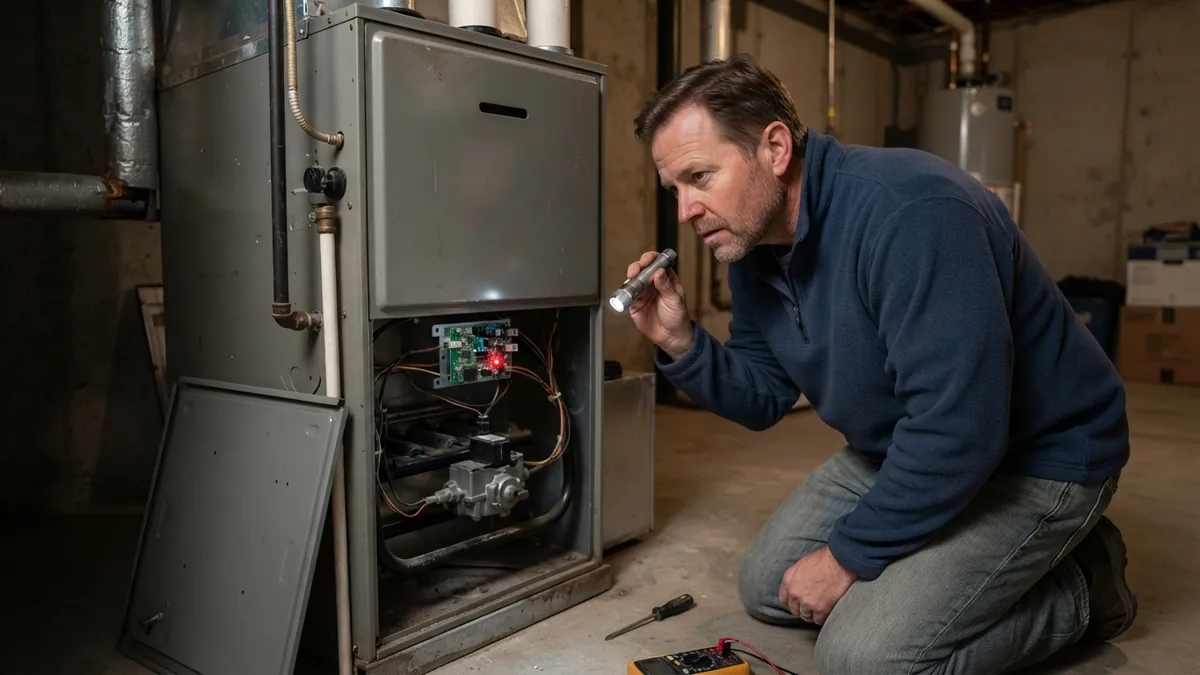
Goodman furnaces, and Amana and Daikin furnaces built by the same company, use a red LED on the control board that flashes a number of times to report a fault. The most common codes are 1 flash (lockout after repeated ignition failures), 3 flashes (pressure switch didn’t close), and 4 flashes (high limit switch open, usually from overheating). Below is the full list for most single-stage and two-stage models, with what each code means and what to do.
Before you start
- Record the code before turning off power. Some boards clear it when power is cut.
- Confirm with the label inside your furnace’s blower door. Codes can differ between control boards and model years.
- Reset only once or twice. Turn off power for 30 seconds and restore it. A code that comes back means a real problem.
- Safety: if you smell gas, leave the home and call your gas utility or 911 from outside. Never bypass a safety switch.
Goodman furnace LED codes
| LED pattern | Meaning | What to check |
|---|---|---|
| Off | No power to the control board | Power switch, breaker, blower door switch, board fuse |
| Steady on | Normal operation | — |
| Rapid flashing | Line voltage polarity reversed | Wiring; electrician or technician |
| 1 flash | Lockout after too many ignition retries | Gas supply, flame sensor, igniter |
| 2 flashes | Pressure switch closed with inducer off | Failed pressure switch or control board |
| 3 flashes | Pressure switch open with inducer on | Blocked vent or intake, clogged drain, cracked hose, weak inducer |
| 4 flashes | High limit switch open | Dirty filter, closed vents, blower problem |
| 5 flashes | Flame sensed with gas valve off | Gas valve or control board; technician |
| 6 flashes | Rollout switch open | Possible blocked or cracked heat exchanger; technician |
| 7 flashes | Low flame signal | Dirty flame sensor, poor ground, weak flame |
| 8 flashes | Igniter fault | Igniter or control board |
| 9 flashes | Grounding problem or reversed polarity | Wiring; technician |
Based on the common Goodman, Amana and Daikin control board chart (reference). Some older boards and communicating (ComfortNet) models use different codes or a two-character display. Check the label on your furnace.
What to do for the most common codes
1 flash: ignition lockout
The furnace tried to light and prove flame several times and gave up. The board usually resets itself after about an hour.
- Make sure the gas valve at the furnace is open and other gas appliances work.
- Clean the flame sensor; it’s the most common cause. See how to clean a furnace flame sensor.
- Watch the startup: if the igniter never glows, see furnace ignitor not glowing.
3 flashes: pressure switch open
The inducer runs, but the pressure switch doesn’t confirm draft.
- On high-efficiency (90%+) furnaces, check the two PVC pipes outside for snow, ice, leaves or nests.
- Check the condensate drain and trap for clogs; water in the pressure switch hose is a common cause.
- Look for a cracked or disconnected rubber hose on the pressure switch.
- If those are clear, the inducer or the switch itself may be failing; call a technician.
4 flashes: high limit open
The furnace is overheating.
- Replace the air filter. See how often to change your air filter.
- Open all supply vents and clear return grilles.
- If it continues, a weak blower motor or failed limit switch is likely. Repeated overheating can damage the heat exchanger.
7 flashes: low flame signal
The furnace lights but the flame signal is weak. Clean the flame sensor and check that the furnace is properly grounded.
When to call a technician
Call a licensed HVAC technician if the same code returns after one reset, or right away for rollout switch, flame-sensed-with-gas-valve-off, gas valve, polarity or control board codes. Give the technician the code, the furnace model number and when the problem started; it speeds up the repair.
For a complete troubleshooting sequence, see Furnace Not Turning On: 11 Causes and Fixes. For other brands, see our furnace blinking light codes guide.
For a deeper look at the two most common faults behind these codes, see furnace pressure switch problems and furnace high limit switch tripping.
Disclaimer: this guide is for general information only and summarizes common Goodman, Amana and Daikin control board codes. Codes vary by model and board; always confirm with the label inside your furnace or the manufacturer’s literature. Gas furnaces involve gas, combustion and high voltage. Contact a licensed HVAC professional for repairs.