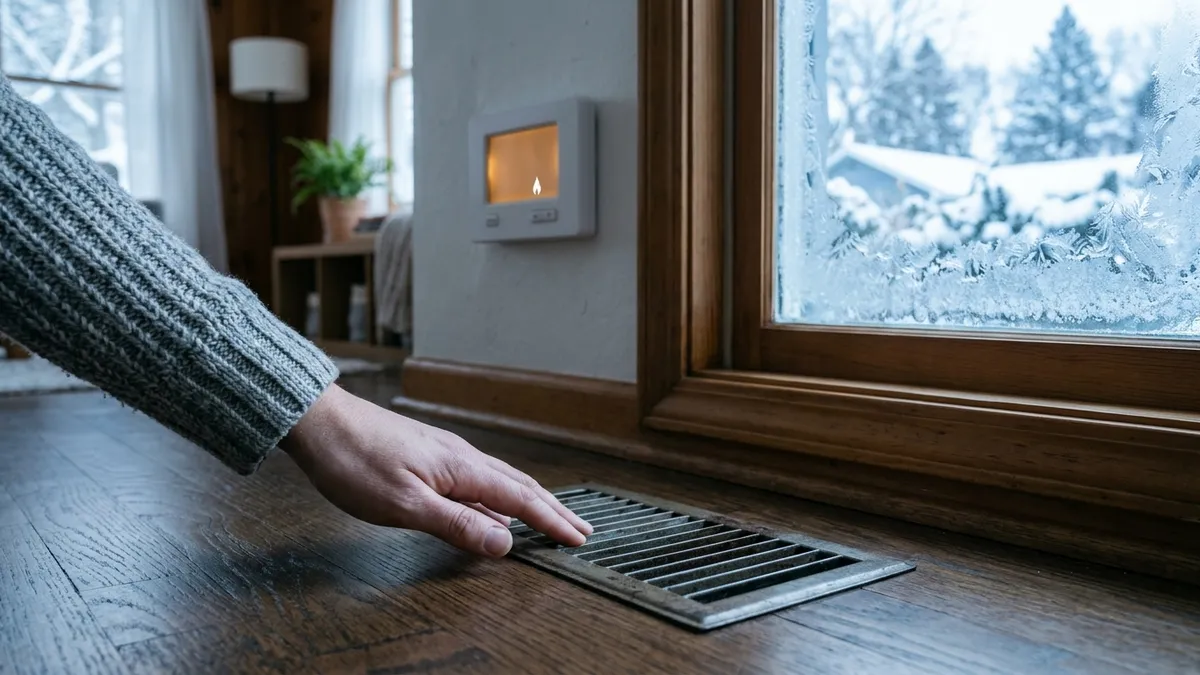
If your thermostat says it’s heating but the house isn’t warming up, the problem is one of three things: the thermostat’s signal isn’t reaching the furnace, the furnace gets the signal but won’t light or stay lit, or it’s heating but the warm air isn’t reaching you. A few quick checks tell you which one, and several of the most common causes take minutes to fix yourself.
Last updated: October 2026. Typical U.S. gas furnaces, heat pumps and electric furnaces.
Start here: what is the system doing?
Go to the furnace or indoor unit while the thermostat calls for heat, and wait about 5 minutes.
| What you notice | Likely problem | Go to |
|---|---|---|
| Nothing at all: no sound, no blower | No power, or the thermostat signal isn’t arriving | Checks 1 to 4 |
| Blower runs but the air is cold | Furnace won’t light or shuts off right after lighting | Checks 5 to 7 |
| Furnace starts, then stops after a few seconds or minutes | Safety shutdown (flame sensor, limit switch, pressure switch) | Checks 6 and 7 |
| Warm air at the vents, but the house stays cold | Airflow, ducts or a system that can’t keep up | Checks 8 and 9 |
| Heat pump: cool air while the outdoor unit runs | Defrost cycle or backup heat issue | Heat pump notes below |
1. Check the thermostat settings
It sounds obvious, but it’s the most common cause:
- The mode is set to Heat, not Cool or Off.
- The setpoint is at least 2 to 3 degrees above the room temperature.
- The fan is set to Auto. With the fan on On, the blower runs all the time and blows unheated air between cycles, which feels like “no heat”.
- No hold, vacation or eco setting is overriding your temperature.
If the thermostat display is blank or dim, replace the batteries first. See thermostat blank screen.
2. Check the furnace power switch and breaker
Most furnaces have a service switch nearby that looks like a light switch, and it’s easy to flip off by mistake. Also check the breaker for the furnace. If either was off, turn it on and give the furnace a few minutes to start.
3. Make sure the furnace door is closed
Furnaces have a door safety switch that cuts power when the front panel isn’t seated properly. If someone recently changed the filter, push the panel firmly into place.
4. Check the thermostat wiring
With the power off, remove the thermostat from its wall plate. The W wire (usually white) carries the call for heat and R is power. A loose W wire means the thermostat says “Heat On” but the furnace never hears it. Check each wire against our thermostat wiring colors chart. If you recently installed a new thermostat, double-check that it’s set for the right system type (gas furnace, heat pump or electric).
5. Look at the furnace status light
Most modern furnaces have a small LED on the control board, visible through a window in the lower panel. A blinking pattern is a code that tells you what’s wrong. See furnace blinking light codes, or the guides for Carrier, Goodman, Trane and Lennox.
6. Watch the ignition sequence
On a gas furnace you should hear the inducer fan start, see the igniter glow orange (or hear a clicking spark), and then see the burners light. Where it stops tells you the cause:
- Igniter never glows: see furnace ignitor not glowing.
- Burners light, then go out within a few seconds: usually a dirty flame sensor. See how to clean a furnace flame sensor.
- Inducer runs, but nothing else happens: often a pressure switch or blocked vent problem.
For the full sequence, see furnace not turning on.
7. Replace a clogged filter
A badly clogged filter makes the furnace overheat, and the high-limit switch shuts the burners off to protect it. The blower keeps running and you get cool air. Replace the filter and see if heat returns. See furnace blowing cold air and furnace short cycling.
8. Check vents and dampers
If warm air is coming out but some rooms stay cold, make sure supply vents and return grilles aren’t blocked by furniture or rugs, and that any duct dampers are open. Leaky ducts in an attic or crawlspace can lose a lot of heat before it reaches the rooms.
9. Ask whether the system can keep up
On the coldest nights, an older or undersized system may run constantly and still fall behind. If the thermostat calls for heat for hours and the temperature only holds steady, the system may simply be too small for the weather, or losing heat through ducts and drafts.
Heat pump notes
If you have a heat pump, a few things look like “no heat” but are normal:
- Defrost mode: in cold, damp weather, the heat pump reverses for 5 to 15 minutes to melt frost off the outdoor coil. Indoor air can feel cool during that time. See heat pump defrost mode.
- Lukewarm air: heat pump air is usually around 90°F to 100°F at the vents, cooler than a gas furnace, so it can feel less warm on your hand even when it’s working.
- Cold air in heat mode for long periods is not normal. See heat pump blowing cold air.
When to call an HVAC technician
Call a licensed technician if the furnace shows a lockout or error code you can’t clear, the igniter or flame sensor fix doesn’t hold, you smell gas, or a breaker trips again after you reset it. If you smell gas, leave the house and call your gas utility from outside.
Two furnace safety switches cause many no-heat calls: see furnace pressure switch problems and furnace high limit switch tripping.
Using an ecobee? See ecobee not heating for ecobee-specific settings.
If you hear the thermostat click and nothing starts, see thermostat clicking but nothing happens.
Frequently asked questions
Why does my thermostat say heat is on but the furnace isn’t running?
Usually the signal isn’t reaching the furnace: a furnace switch or breaker is off, the door panel is loose, or the W wire is loose. If the furnace has power, check its status light for an error code.
Why is my furnace blowing cold air when the heat is on?
Either the fan is set to On instead of Auto, or the burners aren’t lighting or staying lit. A dirty filter or flame sensor is the most common cause.
How long should it take for heat to come on after I turn up the thermostat?
On a gas furnace, warm air usually reaches the vents within 1 to 3 minutes after the burners light. The whole startup, from the inducer fan to warm air, takes a few minutes.
Can a bad thermostat cause no heat?
Yes, but it’s less common than a furnace problem. If the thermostat has power, is set correctly and the wiring is tight, but the furnace never responds, a technician can test whether the thermostat is sending the heat signal.
Disclaimer: this guide is for general information only. Gas furnaces and HVAC systems involve gas, high voltage and combustion. When in doubt, contact a licensed HVAC professional.