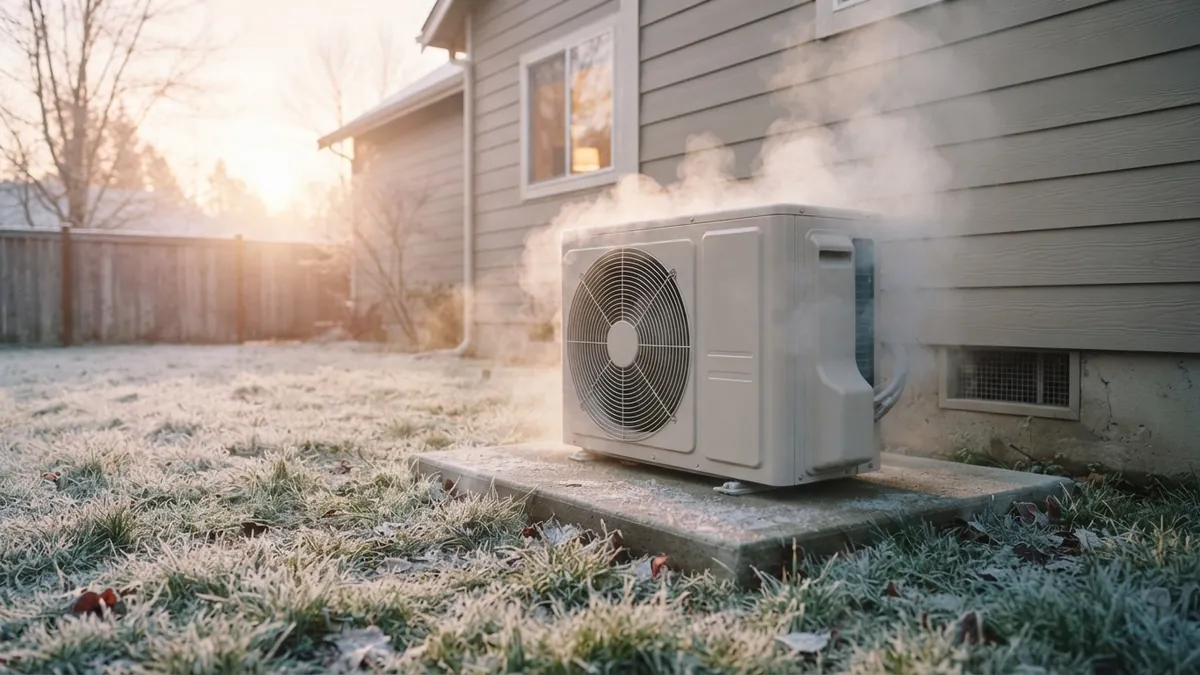
Heat pump defrost mode is normal in cold, damp weather. When frost builds up on the outdoor coil, the heat pump briefly reverses into cooling mode to warm the coil and melt the ice. A typical defrost cycle lasts 5 to 15 minutes and can happen every 30 to 90 minutes in freezing, humid conditions. During defrost the outdoor fan usually stops, you may see steam rising from the unit, and you might hear a whoosh when the reversing valve switches.
Here’s what’s normal, what isn’t, and what to do when defrost isn’t working.
A heat pump covered in thick ice, with ice on the top, the fan or the whole coil, is not normal. It means the defrost system isn’t keeping up or something is blocking airflow or drainage, and the heat pump can’t heat properly until it’s fixed.
Why heat pumps need to defrost
In heating mode, the outdoor coil is colder than the outside air, often below freezing. Moisture in the air freezes on the coil, especially between about 20 and 40°F with high humidity. A layer of frost insulates the coil and blocks airflow, so the heat pump melts it periodically.
What a normal defrost cycle looks like
| What you notice | Normal? |
|---|---|
| Outdoor fan stops while the compressor keeps running | Yes |
| Steam or vapor rising from the outdoor unit | Yes |
| A whoosh or click when it starts and ends | Yes (reversing valve) |
| Water draining from the unit | Yes |
| Cooler air indoors for a few minutes | Normal unless backup heat is on |
| Defrost lasting 5 to 15 minutes | Yes |
| Light frost on the coil between cycles | Yes |
Most heat pumps turn on auxiliary heat during defrost to prevent cold air indoors, so your thermostat may show “aux heat” briefly.
Normal frost vs. a problem
| Condition | Normal? |
|---|---|
| Light white frost on the coil between defrost cycles | Yes |
| Frost that melts within 15 minutes during defrost | Yes |
| Steam rising from the unit | Yes |
| Thick ice on the coil that doesn’t melt | No |
| Ice on the top grille or fan blade | No |
| Ice building up from the base | No |
| Ice on the refrigerant lines in winter | Often a sign of a problem |
How a heat pump decides when to defrost
- Time-and-temperature controls (common on older units) run defrost at set intervals, often every 30, 60 or 90 minutes, if the coil is below a certain temperature.
- Demand defrost (most modern units) uses sensors to defrost only when frost is actually reducing performance, which saves energy.
When defrost is a problem
- Defrost lasts much longer than 15 minutes, or repeats every few minutes.
- Ice keeps building and covers the coil, the top or the base. See the causes below.
- The unit never goes into defrost and the coil becomes a block of ice.
- Loud banging or grinding during defrost.
- The house gets cold during every defrost because backup heat isn’t working.
Common causes include a faulty defrost control board, a failed defrost sensor or thermostat, a stuck reversing valve, low refrigerant, or an outdoor fan relay that doesn’t switch. All require a technician.
Why a heat pump ices up: common causes
- Defrost control problems: a failed defrost board, sensor or thermostat means the unit never enters defrost or ends it too early.
- Stuck reversing valve: the heat pump can’t switch into defrost.
- Outdoor fan not stopping during defrost (a relay problem), so the coil doesn’t warm enough.
- Low refrigerant: colder coil temperatures make ice form faster.
- Water dripping onto the unit from a gutter or roof edge, freezing on top.
- Poor drainage: meltwater can’t drain and refreezes at the base, especially if the unit sits on the ground.
- Snow drifts blocking airflow.
- Freezing rain can coat any unit with ice. This is a weather event; the unit may need help.
What you can do safely
- Switch to emergency heat if the unit is encased in ice, to protect the outdoor unit while you deal with it. See heat pump emergency heat.
- Clear snow from around and on top of the unit with a broom; keep 2 feet of clearance.
- Melt light ice by pouring warm (not boiling) water over the coil and top with the unit off.
- Never chip ice with a shovel, screwdriver or hammer; the fins and refrigerant tubes are easily punctured.
- Fix the source of dripping water, such as a clogged or missing gutter above the unit.
- Raise the unit on a stand or wall bracket if it sits low and ice builds from the base.
When to call a technician
- Ice returns within a day after you’ve cleared it.
- The unit never seems to go into defrost (no steam, no fan stop).
- You see ice on the refrigerant lines or hear unusual noises.
- The heat pump is running but your home isn’t warming.
Defrost board or sensor repairs typically cost $150 to $600; reversing valve replacement and refrigerant leak repairs cost more.
Seeing aux heat run during or after defrost on an ecobee? See ecobee aux heat running too much.
If the heat pump starts and stops every few minutes outside of defrost, see heat pump short cycling.
Frequently asked questions
How long should a heat pump defrost cycle last?
Typically 5 to 15 minutes.
How often should a heat pump go into defrost?
It depends on temperature and humidity; every 30 to 90 minutes is common in freezing, damp weather. Demand-defrost units may go hours without one in dry cold.
Is steam coming from my heat pump normal?
Yes. It’s water from the melting frost evaporating off the warm coil.
Why does my heat pump blow cold air during defrost?
The heat pump is temporarily in cooling mode. If backup heat doesn’t come on, you’ll feel cool air for a few minutes. See heat pump blowing cold air in heat mode.
Is it bad if my heat pump freezes up?
Light frost is normal. A unit that stays iced over can’t heat efficiently, and running it that way can damage the fan or coil.
Should I turn off my heat pump if it’s frozen?
Switch to emergency heat (or off) until the ice clears, then switch back to heat and watch it. Call a technician if it refreezes.
Can I pour hot water on my heat pump?
Warm water is fine for light ice with the unit off. Avoid boiling water, which can damage components.
Disclaimer: this guide is for general information only. HVAC systems involve high voltage and refrigerant. When in doubt, contact a licensed HVAC professional.