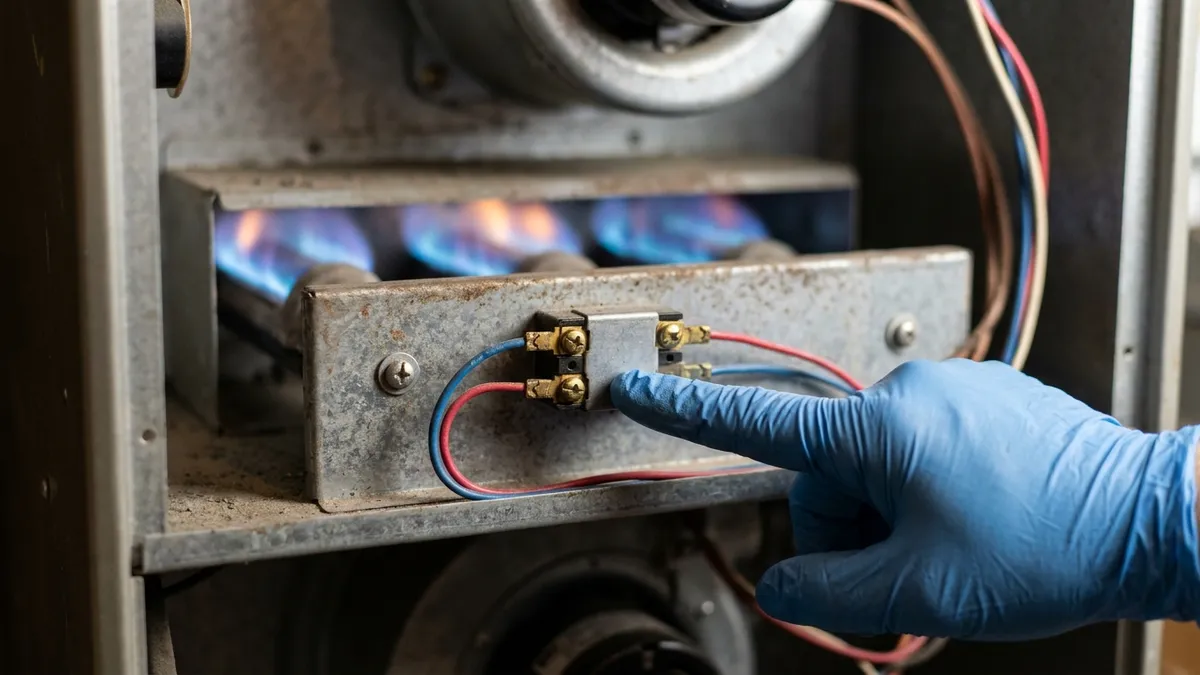
The high limit switch is a temperature safety switch that shuts off a furnace’s burners when the inside of the furnace gets too hot. When it trips, the blower keeps running to cool things down, so you get cold air from the vents and the furnace may cycle on and off every few minutes. In most cases the limit switch is doing its job correctly, and the real problem is not enough airflow through the furnace, usually a dirty filter.
Last updated: November 2026. Applies to most gas furnaces; electric furnaces use similar limits on their heating elements.
What the high limit switch does
A gas furnace heats air by passing it over a hot heat exchanger. If not enough air moves across the heat exchanger, the temperature inside the furnace climbs. Overheating can crack the heat exchanger, which can let carbon monoxide escape into the air you breathe.
The high limit switch is a small disc or probe mounted on the furnace’s sheet metal near the heat exchanger. When the temperature passes its rated limit, it opens, and the control board shuts off the gas. The blower keeps running until the furnace cools down. Once it cools, the switch closes again and the furnace tries to restart.
That pattern explains the typical symptoms:
- Burners light, run for a few minutes, then shut off, while the blower keeps running.
- Cold or lukewarm air from the vents for long stretches.
- The furnace cycles on and off repeatedly without warming the house. See furnace short cycling.
- A limit error code on the furnace’s status light.
High limit error codes by brand
| Brand | Limit switch code |
|---|---|
| Carrier, Bryant, Payne | Code 33 (limit circuit fault); code 13 (limit circuit lockout) |
| Goodman, Amana | 4 flashes (high limit switch open) |
| Trane, American Standard | 4 flashes (open limit switch) |
| Lennox | E250 (limit switch circuit open); E274 (lockout from repeated limit trips) |
Codes vary by model, so check the label on your furnace door. See Carrier, Goodman, Trane and Lennox furnace codes.
Why a high limit switch trips
Almost every cause comes back to airflow: something stops enough air from moving through the furnace.
| Cause | How common | Fix |
|---|---|---|
| Dirty or clogged air filter | Very common | Replace the filter |
| Closed or blocked supply vents and return grilles | Common | Open vents, clear furniture and rugs |
| Wrong filter (too restrictive) | Common | Use the filter the furnace was designed for |
| Dirty blower wheel | Occasional | Professional cleaning |
| Failing blower motor or capacitor | Occasional | Technician repair |
| Undersized or collapsed ductwork | Occasional | Duct repair or redesign |
| Dirty evaporator coil above the furnace | Occasional | Coil cleaning |
| Over-firing (gas pressure too high) | Rare | Technician adjustment |
| Failed limit switch | Rare | Switch replacement |
The filter is the first thing to check
A clogged filter is by far the most common reason a limit switch trips. If you can’t see light through the filter, replace it. Thick, high-MERV filters can also restrict airflow on furnaces that weren’t designed for them. See how often to change your air filter and MERV 8 vs. MERV 11 vs. MERV 13.
What you can do
- Replace the filter. Then turn the furnace off at its service switch for 30 seconds and back on to clear any lockout.
- Open all supply vents and clear the returns. Closing vents in unused rooms to “save energy” raises the pressure in the ducts and can trip the limit.
- Check the blower. With the furnace running, make sure air is coming strongly from the vents. Weak airflow everywhere points to a blower or duct problem.
- Watch how long it runs. If the burners now run until the thermostat is satisfied, the problem is solved.
What not to do
Never bypass or jumper a limit switch. It’s one of the furnace’s most important safety controls. A furnace that overheats repeatedly can crack its heat exchanger, which is expensive and can be dangerous. Make sure you have working carbon monoxide detectors.
Limit switch vs. rollout switch
They’re easy to confuse. The high limit switch protects against overheating from poor airflow, and it resets on its own when the furnace cools. The flame rollout switch sits near the burners and trips when flames roll out of the burner area, often because of a blocked flue or a cracked heat exchanger. Many rollout switches must be reset by hand with a small button. If a rollout switch trips, call a technician rather than resetting it repeatedly, because it can signal a venting or heat exchanger problem.
When to call an HVAC technician
Call a licensed technician if the limit keeps tripping with a clean filter and open vents, airflow is weak at every vent, you hear unusual noises from the blower, or the furnace shows a rollout code. A technician can measure the temperature rise across the furnace and compare it to the range on its rating plate, which shows whether the problem is airflow, gas pressure or the switch.
Typical costs: replacing a limit switch usually costs $150 to $350; a blower motor replacement often runs $400 to $1,500, depending on the motor type.
If the blower keeps running long after the burners shut off, see furnace blower won’t turn off.
Frequently asked questions
Can a dirty filter cause a furnace to overheat?
Yes. It’s the most common cause. Less air across the heat exchanger means the furnace runs hotter until the high limit switch shuts off the burners.
Does a high limit switch reset itself?
Most do, once the furnace cools down. If the furnace has locked out after several trips, you may need to turn the power off and back on. Some furnaces also have a manual-reset limit or rollout switch with a small button.
Why is my furnace blowing cold air after running for a few minutes?
That’s the classic limit switch pattern: the burners shut off on high temperature while the blower keeps running. Check the filter first. For other causes, see furnace blowing cold air.
Is a tripped limit switch dangerous?
The switch tripping is the furnace protecting itself, which is good. The danger is ignoring repeated trips or bypassing the switch, which can damage the heat exchanger.
Disclaimer: this guide is for general information only. Gas furnaces involve gas, combustion and high voltage. If you smell gas, leave the house and call your gas utility from outside. When in doubt, contact a licensed HVAC professional.