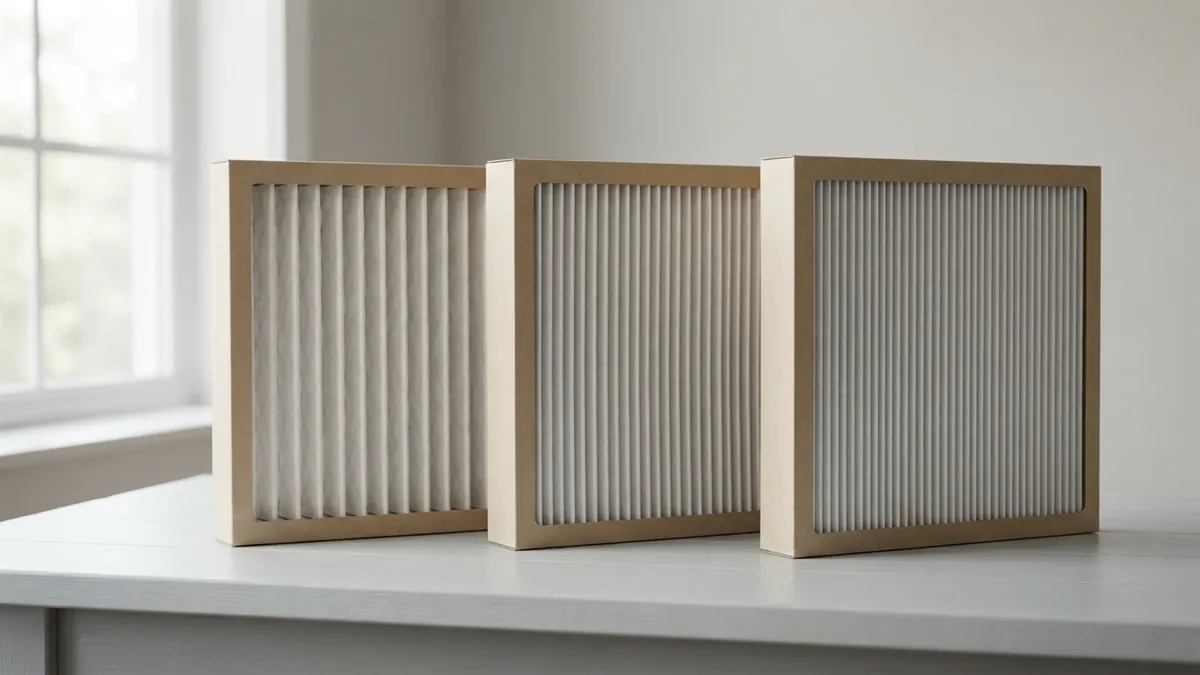
For most homes, a MERV 8 to MERV 11 air filter is the best choice: it captures dust, pollen, mold spores and pet hair without choking your system’s airflow. Choose MERV 13 if someone in your home has allergies or asthma, you have pets, or you deal with wildfire smoke, but first make sure your system can handle it, ideally with a 4-inch or 5-inch filter instead of a 1-inch one.
Here’s what the numbers mean, how the three compare, and how to tell whether MERV 13 is safe for your system.
Quick comparison
| MERV 8 | MERV 11 | MERV 13 | |
|---|---|---|---|
| Captures | Dust, lint, pollen, mold spores, pet hair | Everything MERV 8 catches, plus finer dust, pet dander, some smoke | Everything MERV 11 catches, plus smoke, fine particles, many bacteria and virus-carrying droplets |
| Fine particles (0.3 to 1 micron) | Low capture | Low to moderate | At least 50% |
| Airflow restriction (1-inch) | Low | Moderate | Higher |
| Typical price per 1-inch filter | $5 to $12 | $8 to $18 | $12 to $25 |
| Best for | Most homes, equipment protection | Pets, mild allergies | Allergies, asthma, wildfire smoke |
Prices are typical retail ranges for common sizes and vary by brand and pack size.
What MERV means
MERV stands for Minimum Efficiency Reporting Value. It comes from the ASHRAE 52.2 test standard, which measures how well a filter captures particles in three size ranges:
- E1: 0.3 to 1 micron. Smoke, bacteria, fine combustion particles. The hardest to catch and the most relevant to lung health.
- E2: 1 to 3 microns. Fine dust, pet dander, mold spores, some bacteria.
- E3: 3 to 10 microns. Pollen, larger dust, lint.
Higher MERV means better capture in the smaller size ranges:
| Rating | E1 (0.3 to 1 µm) | E2 (1 to 3 µm) | E3 (3 to 10 µm) |
|---|---|---|---|
| MERV 8 | — | 20% or more | 70% or more |
| MERV 11 | 20% or more | 65% or more | 85% or more |
| MERV 13 | 50% or more | 85% or more | 90% or more |
For a human hair, think about 50 to 70 microns. Most of the particles that bother allergy and asthma sufferers are far smaller.
MERV 8: the reliable default
A MERV 8 pleated filter is a big step up from cheap fiberglass filters (MERV 1 to 4), which mostly protect the equipment and do little for air quality. MERV 8 catches the bulk of household dust and pollen and keeps the blower and coil clean, with minimal airflow restriction. It’s what many HVAC manufacturers and technicians recommend as the baseline for standard systems.
Choose MERV 8 if: no one in the home has allergies, you have no pets, or your system is older or already has weak airflow.
MERV 11: the sweet spot for many homes
MERV 11 starts capturing a meaningful share of the smaller particles, including pet dander and finer dust, while keeping airflow reasonable in most systems.
Choose MERV 11 if: you have pets, mild seasonal allergies, or you want noticeably less dust without worrying about airflow.
MERV 13: best filtration, with a caveat
MERV 13 captures at least half of the finest particles. The EPA has recommended MERV 13 or the highest rating your system can accommodate during wildfire smoke events and to reduce airborne particles indoors.
The caveat is airflow. A denser filter creates more resistance (pressure drop). In a system designed for low-resistance filters, a 1-inch MERV 13 filter can reduce airflow, which can lead to:
- Longer run times and higher energy use.
- Reduced comfort.
- In cooling mode, a frozen evaporator coil.
- In heating mode, a furnace overheating and shutting off on its safety limit.
Choose MERV 13 if: someone has allergies or asthma, you live in an area with wildfire smoke, or a technician confirms your system handles it. Your best option is a 4- or 5-inch MERV 13 media filter, which has far more surface area and much lower resistance than a 1-inch filter at the same rating.
How to tell if your system can handle MERV 13
- Check your equipment manual. Some manufacturers list a maximum filter resistance or recommended filter types.
- Ask your technician to measure static pressure with the new filter installed. This is the most reliable test.
- Watch for warning signs after switching: weaker airflow at the vents, a whistling filter slot, longer run times, ice on refrigerant lines in summer, or the furnace cycling off in winter. If you notice these, go back to MERV 11.
- Consider a media cabinet. A contractor can install a 4- or 5-inch filter housing, usually for a few hundred dollars, so you get MERV 13 filtration with low resistance.
What about MPR and FPR ratings?
Some retailers and brands use their own scales instead of, or alongside, MERV. 3M Filtrete uses MPR (Microparticle Performance Rating), and Home Depot’s store brand uses FPR (Filter Performance Rating). They’re not official standards. Roughly speaking, MPR 1000 and FPR 7 filters land around MERV 11 to 12, and MPR 1500 to 1900 and FPR 10 filters around MERV 13. Check the package for the MERV rating when it’s listed.
Does a higher MERV filter need changing more often?
Often yes. Because it catches more, a high-MERV filter can load up faster, especially in homes with pets or during smoke events. Check it monthly. See our full air filter replacement schedule.
Frequently asked questions
Is MERV 13 too restrictive for a home HVAC system?
It depends on the system and the filter thickness. Many modern systems handle MERV 13 fine, especially with 4-inch filters. Older systems or undersized return ducts may struggle with 1-inch MERV 13 filters.
Is MERV 11 good enough for allergies?
For mild allergies, often yes. For moderate to severe allergies or asthma, MERV 13, or MERV 13 plus a portable HEPA air purifier in the bedroom, is a better choice.
Is MERV 8 good for pets?
It catches pet hair well, but MERV 11 or higher captures more of the smaller dander particles that cause allergy symptoms.
Are HEPA filters better than MERV 13?
HEPA filters capture even more fine particles, but standard home HVAC systems usually can’t push enough air through them. HEPA works best in portable air purifiers or dedicated bypass systems.
Disclaimer: this guide is for general information. Check your HVAC equipment manufacturer’s recommendations before changing filter type.