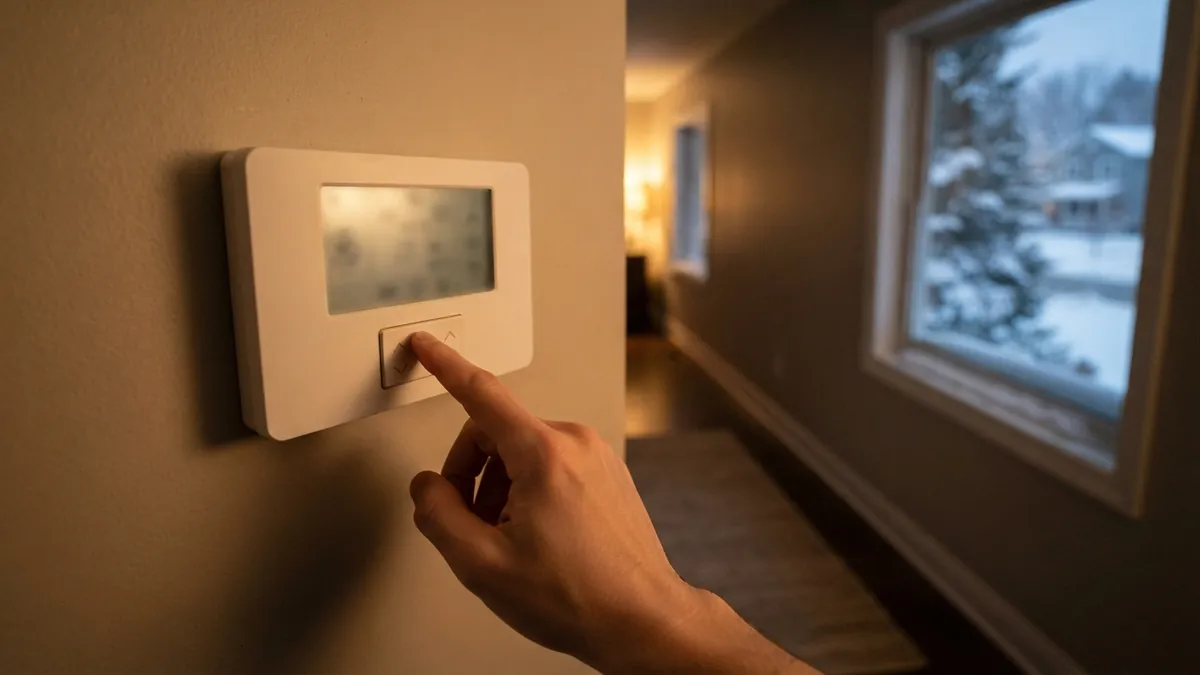
Emergency heat (EM HEAT) is a thermostat setting that shuts off your heat pump’s outdoor unit and heats your home using only the backup heat source, usually electric resistance strips in the air handler. Use it only when the heat pump itself has failed or is damaged, not because it’s cold outside. Electric strip heat typically costs 2 to 3 times more to run than the heat pump, so leaving the system on emergency heat can double or triple a winter electric bill.
Emergency heat vs. auxiliary heat
| Auxiliary (aux) heat | Emergency (EM) heat | |
|---|---|---|
| How it turns on | Automatically, by the thermostat | Manually, by you |
| Heat pump running? | Yes; backup heat supplements it | No; outdoor unit is off |
| When it’s used | Very cold days, defrost cycles, large temperature jumps | Heat pump failure or damage |
| Cost | Moderate increase | High |
Seeing “AUX” on your thermostat during cold snaps or defrost is normal. You shouldn’t need to touch EM HEAT unless something is wrong.
When to use emergency heat
- The outdoor unit is damaged (a fallen branch, a storm, a vehicle).
- The outdoor unit is encased in ice that won’t clear (see heat pump covered in ice).
- The heat pump has failed and you’re waiting for a technician.
- A technician tells you to use it.
Switch back to normal HEAT as soon as the heat pump is repaired.
When not to use it
- Just because it’s very cold outside. Cold-climate heat pumps keep working at low temperatures, and the thermostat brings on aux heat automatically when needed. See do heat pumps work in cold climates.
- During normal defrost cycles. See heat pump defrost mode.
- To warm the house faster. It won’t heat much faster and costs much more.
What emergency heat costs
Electric resistance heat produces 3,412 BTU per kWh, the same as a space heater. A heat pump typically produces 2 to 3 times as much heat per kWh in mild winter weather. With electricity at $0.17 per kWh, delivering 1 million BTU costs about $50 with strip heat versus roughly $17 to $25 with a heat pump. See heat pump vs. furnace for the full comparison.
If your home uses a gas furnace as backup (dual fuel), emergency heat runs the furnace, which may cost less than strip heat.
Why aux heat might run too much
If your thermostat shows aux heat running often on moderate days (above about 35°F), check:
- Thermostat settings: aux heat lockout temperature, droop or differential settings, and whether “smart recovery” brings on strips to recover from a setback. Smaller setbacks help.
- A dirty filter or blocked outdoor unit.
- Low refrigerant or a failing heat pump, which makes the thermostat call for backup.
- An undersized heat pump. See our heat pump size calculator.
Smart thermostats such as Ecobee and Nest let you set the outdoor temperature below which aux heat may run. See Ecobee aux heat running too much.
If your thermostat runs aux heat more than it should, see Nest thermostat using aux heat too much or ecobee aux heat running too much.
A heat pump that keeps turning on and off can also push the system onto backup heat. See heat pump short cycling.
Frequently asked questions
Should I use emergency heat when it’s below freezing?
No. Use normal heat mode; the thermostat will use aux heat automatically if the heat pump needs help.
Can emergency heat damage my system?
No, but it’s expensive. Some strip heaters also need their own breakers on, so check the panel if EM heat doesn’t produce warm air.
Why is my thermostat stuck on emergency heat?
It may have been switched manually, or some thermostats switch to it after detecting a heat pump fault. Switch back to HEAT and call a technician if the heat pump doesn’t run.
Disclaimer: this guide is for general information only. HVAC systems involve high voltage and refrigerant. When in doubt, contact a licensed HVAC professional.