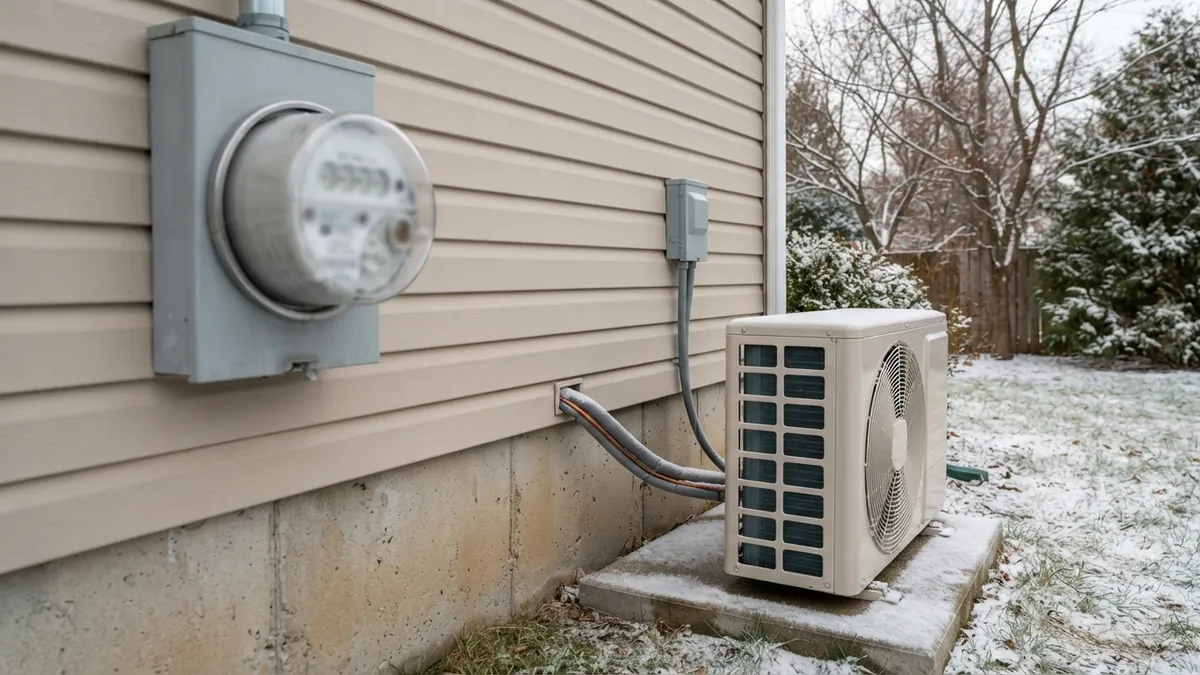
A typical central heat pump uses roughly 1 to 4 kWh per hour of operation, depending on its size, efficiency and the outdoor temperature. Over a month, that often adds up to about 300 to 1,500 kWh for a typical home: less in mild weather and more in very cold or very hot months, especially if backup strip heat runs. At $0.17 per kWh, that’s roughly $50 to $250 a month.
Here’s how to estimate your own usage and cost.
Heat pump electricity use by size
| Size | Typical power draw while running | Typical kWh per hour |
|---|---|---|
| 2 tons | 1.5 to 2.5 kW | 1.5 to 2.5 |
| 3 tons | 2 to 3.5 kW | 2 to 3.5 |
| 4 tons | 3 to 4.5 kW | 3 to 4.5 |
| 5 tons | 3.5 to 5.5 kW | 3.5 to 5.5 |
| Electric backup strips (each 5 kW) | 5 kW per strip | 5 per strip |
Variable-speed heat pumps often run longer at lower power, so they draw less per hour than these figures most of the time.
Estimated monthly usage and cost
| Season / climate | Typical monthly kWh (2,000 sq ft home) | Cost at $0.17/kWh |
|---|---|---|
| Mild spring or fall | 200 to 400 | $35 to $70 |
| Summer cooling, moderate climate | 500 to 900 | $85 to $155 |
| Summer cooling, hot climate | 900 to 1,500 | $155 to $255 |
| Winter heating, mild climate | 500 to 900 | $85 to $155 |
| Winter heating, cold climate | 1,000 to 2,000+ | $170 to $340+ |
Estimates for illustration; your home’s insulation, thermostat settings and equipment change the numbers substantially.
How to estimate your own usage
Method 1: Use the power rating. Multiply the heat pump’s running power (in kW, from the spec sheet or a technician’s measurement) by the hours it runs. Example: 3 kW × 8 hours = 24 kWh per day, or about 720 kWh a month.
Method 2: Use SEER2 for cooling. Seasonal cooling kWh ≈ (cooling load in BTU over the season) ÷ (SEER2 × 1,000). A 36,000 BTU system running 1,000 full-load hours with a SEER2 of 16 uses about 36,000 × 1,000 ÷ 16,000 = 2,250 kWh per season.
Method 3: Use HSPF2 for heating. Seasonal heating kWh ≈ (heat delivered in BTU) ÷ (HSPF2 × 1,000). Higher HSPF2 means less electricity per unit of heat.
Method 4: Check your bill. Compare winter and summer bills with spring or fall months, when heating and cooling are minimal. The difference is mostly your HVAC.
What makes a heat pump use more electricity
- Backup strip heat. It uses 2 to 3 times more electricity than the heat pump for the same heat. See heat pump emergency heat.
- Very cold or very hot weather.
- Dirty filters and coils. See our HVAC maintenance checklist.
- Large thermostat setbacks that force strip heat to recover.
- Leaky ducts in unconditioned spaces.
- Low refrigerant.
- An oversized or undersized system.
How to reduce heat pump electricity use
- Keep setbacks small (2 to 4 degrees) in winter.
- Set an aux heat lockout temperature on smart thermostats.
- Change filters on schedule and keep the outdoor unit clear.
- Seal and insulate ducts and the attic.
- When replacing, choose higher SEER2 and HSPF2 ratings, especially in extreme climates.
Aux heat is the biggest driver of high heat pump bills. On a Nest, see Nest thermostat using aux heat too much.
Frequently asked questions
Does a heat pump use a lot of electricity?
It uses more electricity than a gas furnace, which burns gas instead, but much less than electric resistance heating for the same amount of heat.
How many kWh does a heat pump use per day?
Often 10 to 60 kWh per day, depending on size, weather and settings.
Is it cheaper to run a heat pump all day?
In winter, holding a steady temperature or using small setbacks is usually cheaper than large setbacks that trigger backup heat.
Disclaimer: usage and cost figures are estimates for general information. Actual consumption depends on your home, climate, equipment and utility rates.