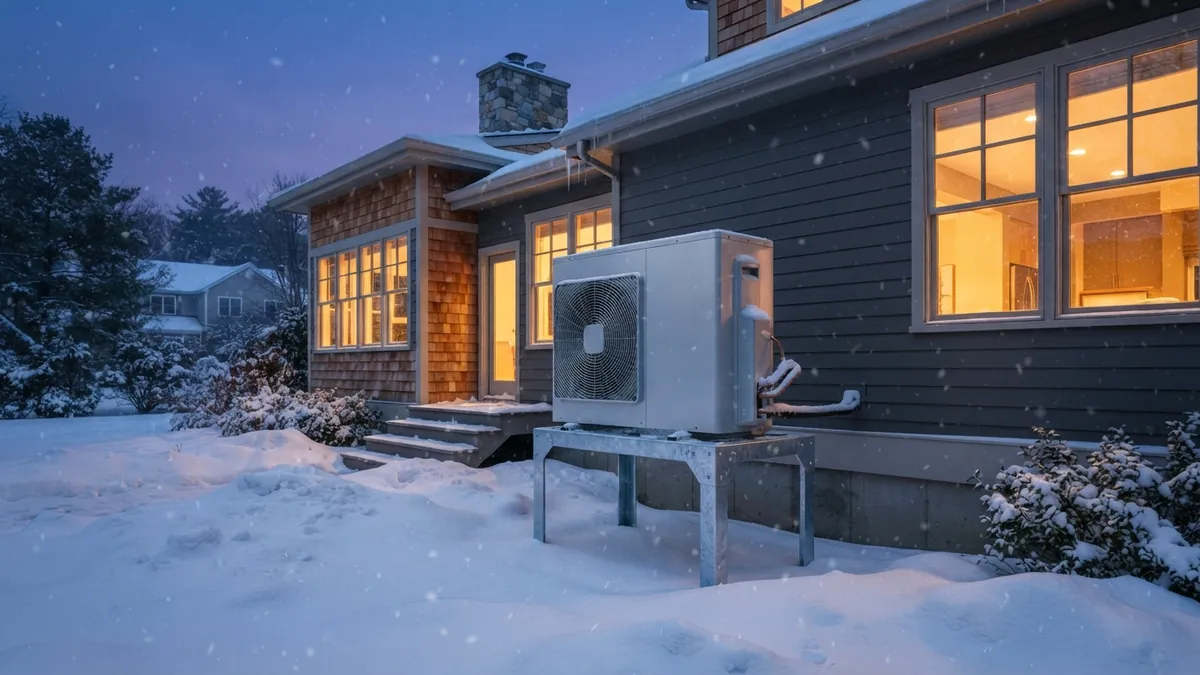
Yes, modern heat pumps work in cold climates. Standard air-source heat pumps heat efficiently down to roughly 25 to 30°F, and cold-climate heat pumps are designed to keep delivering most of their rated capacity at 5°F and to keep running well below 0°F. Below that, most homes rely on backup heat, either electric resistance strips or a gas furnace in a dual-fuel system.
Here’s how heat pumps perform in the cold, what to look for in a cold-climate model, and how to size one so you stay warm.
How a heat pump heats when it’s cold outside
Even 0°F air contains heat. A heat pump uses refrigerant that boils at very low temperatures to absorb that heat outdoors, compresses it to raise its temperature, and releases it inside. As the outdoor temperature falls:
- Efficiency (COP) drops, but usually stays above 1.5 to 2 even near 0°F on cold-climate models, meaning it still delivers more heat than an electric resistance heater using the same electricity.
- Capacity drops on standard models, which is why sizing for your coldest days matters.
- Defrost cycles become more frequent as frost forms on the outdoor coil. That’s normal. See heat pump defrost mode.
Standard vs. cold-climate heat pumps
| Standard heat pump | Cold-climate heat pump | |
|---|---|---|
| Compressor | Usually single- or two-stage | Variable-speed (inverter), often with vapor injection |
| Comfortable operating range | Down to about 25 to 30°F, then backup heat | Rated capacity at 5°F; many run down to -13°F or lower |
| Capacity at 5°F | Often 50 to 60% of rated | Often 70 to 100% of rated |
| Typical cost | Lower | Higher (often $2,000 to $5,000 more) |
| Best for | Mild and mixed climates | Cold and very cold climates |
The Northeast Energy Efficiency Partnerships (NEEP) maintains a widely used list of cold-climate air-source heat pumps with performance data at 5°F. Ask your contractor whether the model they quote is on it.
How cold-climate homes stay warm
- Size for heating. In cold climates, the heating load on the coldest days decides the size. See our heat pump size calculator.
- Check capacity at 5°F, not just the nominal tonnage.
- Plan backup heat: electric strips inside the air handler, or keep a gas furnace as a dual-fuel system.
- Improve the building envelope. Air sealing and insulation reduce the heating load and let a smaller heat pump do more of the work.
- Elevate the outdoor unit above expected snow depth and keep it clear of drifts and roof runoff.
Operating costs in cold weather
Even at lower efficiency, a cold-climate heat pump is usually cheaper to run than propane, oil or electric resistance heat, and can be competitive with natural gas depending on local prices. See the math in our heat pump vs. furnace comparison.
Common cold-weather concerns
- “The air feels cooler than a furnace.” Heat pumps deliver air around 90 to 100°F instead of 120°F or more. They run longer, gentler cycles. See heat pump blowing cold air in heat mode.
- Steam from the outdoor unit during defrost is normal.
- Ice buildup that doesn’t clear is not normal. See heat pump covered in ice.
- Aux heat running a lot on moderate days usually points to a thermostat setting or sizing issue. See heat pump emergency heat.
Frequently asked questions
At what temperature does a heat pump stop working?
Standard heat pumps lose much of their capacity below about 25°F. Many cold-climate models keep heating down to -13°F to -22°F, depending on the model.
Are heat pumps worth it in Minnesota or Maine?
Many homes in very cold states use cold-climate heat pumps successfully, usually with backup heat for the coldest days. Good insulation and correct sizing are key.
Do heat pumps use more electricity in cold weather?
Yes. Efficiency drops and run time increases as it gets colder, and backup heat uses much more electricity.
Disclaimer: this guide is for general information only. HVAC systems involve high voltage and refrigerant. When in doubt, contact a licensed HVAC professional.