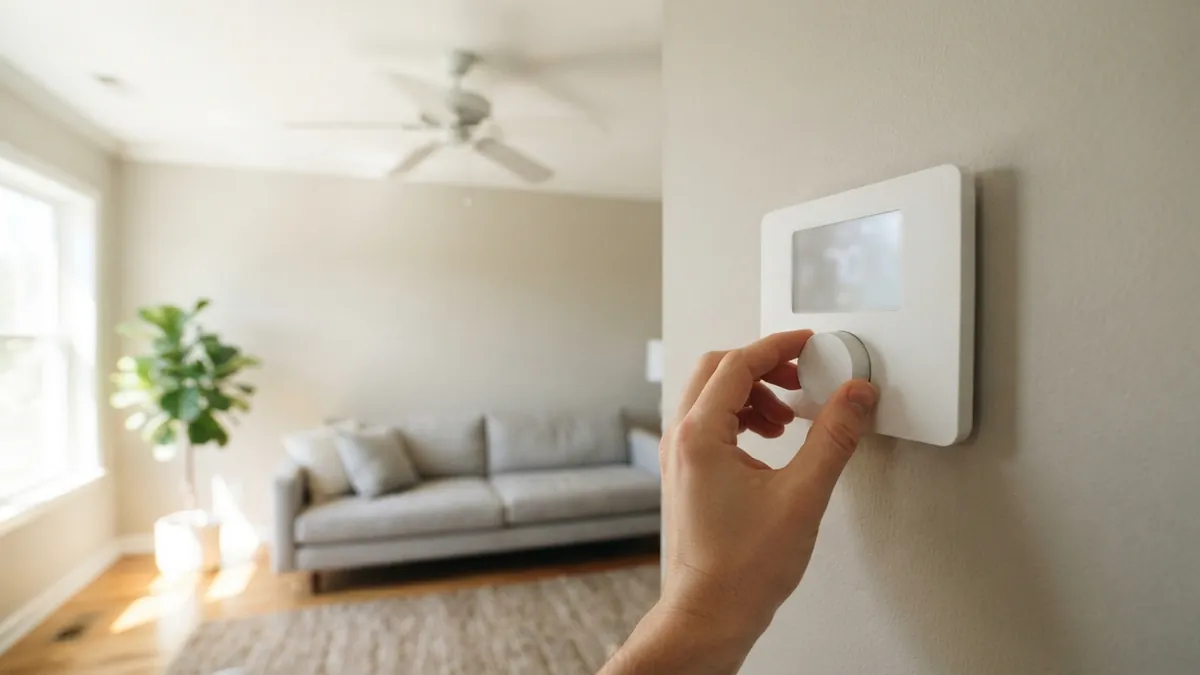
The U.S. Department of Energy suggests setting your thermostat to 78°F when you’re home and awake in summer, and higher when you’re asleep or away, as a balance between comfort and savings. Each degree you raise the setpoint can save roughly 1 to 3% on cooling costs, depending on climate. Many households are comfortable at 74 to 78°F, especially with ceiling fans.
Here’s a practical schedule, plus the mistakes that make your AC work harder without making you cooler.
Recommended summer thermostat settings
| Situation | Suggested setting |
|---|---|
| Home and awake | 76 to 78°F |
| Sleeping | 78 to 82°F (or cooler if you sleep poorly when warm; use a fan) |
| Away for the workday | 82 to 85°F |
| Away on vacation | 85°F (keep humidity under control; don’t turn it off in humid climates) |
| Pets at home | 78 to 80°F, depending on the pet |
The Department of Energy notes that turning your thermostat back 7 to 10°F for 8 hours a day can save up to about 10% a year on heating and cooling.
Tips that save the most
- Use ceiling fans. Set them counterclockwise in summer. The breeze can make a room feel about 4°F cooler, so you can raise the thermostat. Turn them off when you leave the room; fans cool people, not rooms.
- Use a programmable or smart thermostat so the temperature rises automatically when you’re away and drops before you return.
- Close blinds on sunny windows in the afternoon.
- Avoid heat-producing chores (oven, dryer) during the hottest hours.
- Keep the system maintained. A dirty filter or coil makes every setting cost more. See our HVAC maintenance checklist.
Mistakes to avoid
- Setting it very low to cool faster. A central AC cools at the same speed whether the setpoint is 72 or 65°F. A low setpoint just means it runs longer and overcools.
- Turning the AC off completely in humid weather while you’re away. The house can get muggy, and moisture can lead to mold. Raise the setpoint instead.
- Setting the fan to ON all day in humid climates, which can re-evaporate moisture from the coil back into the air.
- Huge setbacks with older systems in extreme heat. If your AC already struggles on hot afternoons, a smaller setback is better; the system may not be able to recover from 85 to 76°F before evening.
What about humidity?
Comfort depends on humidity as well as temperature. Indoors, 40 to 50% relative humidity feels good in summer. If your home feels clammy at 76°F, the AC may be oversized or short cycling (see AC short cycling), or the fan may be set to ON.
Frequently asked questions
Is 72°F too cold for AC in summer?
It’s not harmful, but it’s more expensive than 76 to 78°F, and some systems struggle to hold 72°F on very hot days.
What temperature should I set my AC when I’m on vacation?
Around 85°F, or a bit lower in very humid climates to control moisture.
Does turning the AC off during the day save money?
Raising the setpoint saves money. Turning it off completely can work in dry climates but can leave a humid house that takes a long time to cool down in humid ones.
What’s the best temperature to sleep with AC?
Many people sleep best in a cool room. If 78°F is too warm, try 74 to 76°F with a ceiling fan.
If your AC can’t reach your setpoint, see AC Not Cooling? 12 Causes and How to Fix Each One.
Disclaimer: savings estimates are general and vary by home, climate and equipment.